Online Courses in AI, Cybersecurity, Mathematics & More
Welcome to Serious Courses!
Your gateway to a Celestial Library of Learning. Here, each course is a star in a vast constellation of knowledge, handpicked for seekers of mastery. Some glimmer behind paywalls, others shine freely in the open sky—but all are portals to deeper understanding. Know of a course that belongs among these stars? Whisper it to us at support@seriousmindware.com. The archive expands with every voice.
From the Serious Courses blog.
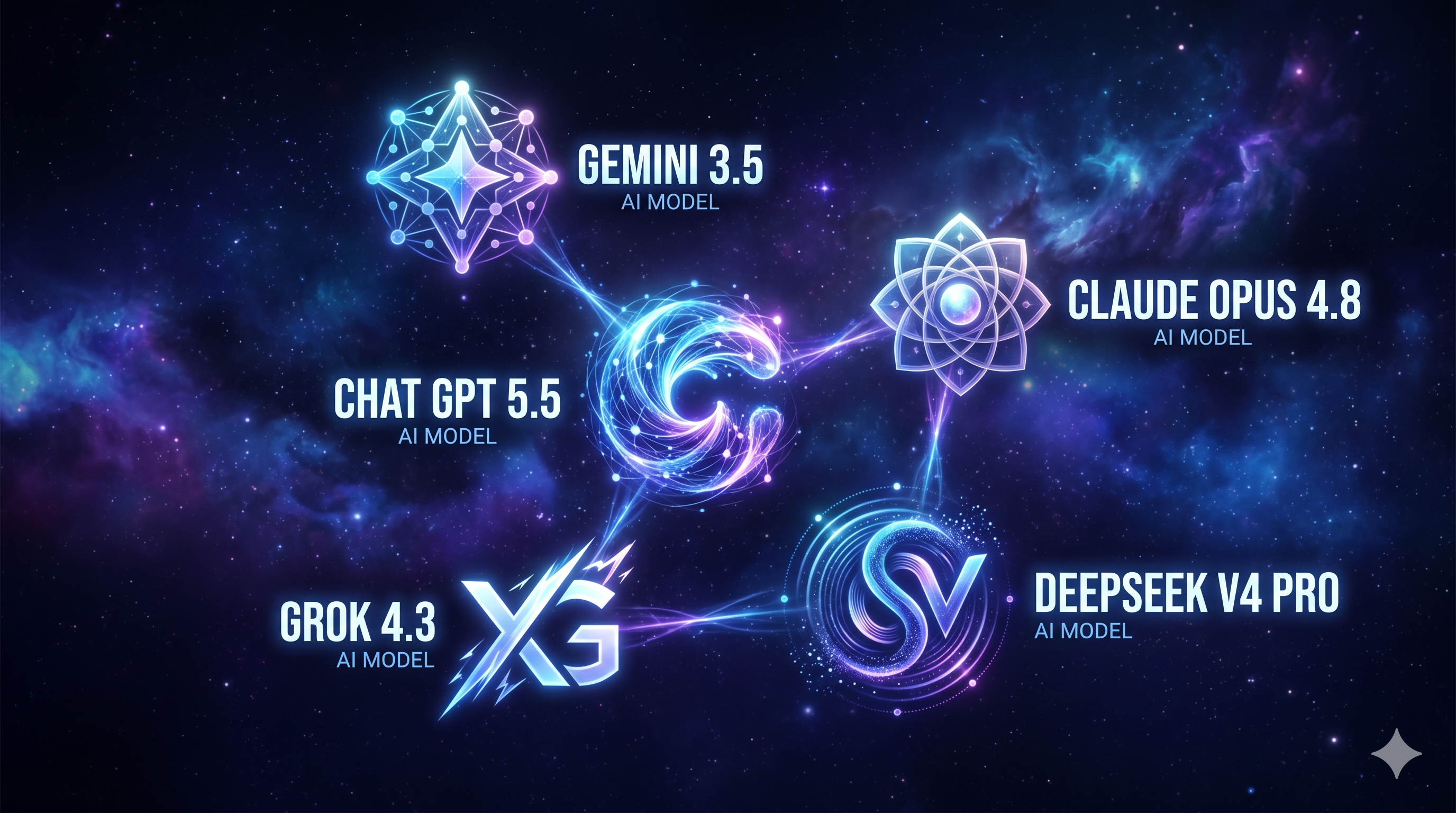
🌌 The AI Model Landscape in Mid-2026: A Guide to the Frontier
Serious Courses! The AI landscape in mid-2026 looks nothing like it did just eighteen months ago. Frontier models aren't just smarter — they're becoming autonomous agents capable of planning, tool use, and multi-step execution across hours-long tasks. Whether you're a developer evaluating which model to build on, or a curious learner trying to make sense of the headlines, here's a clear-eyed guide to the major players and what each one actually does well.
🧠 Claude Opus 4.8 — Anthropic
Best for: Deep reasoning, long-context analysis, safety-conscious deployments
Claude Opus 4.8 currently sits at the top of the Artificial Analysis Intelligence Index, edging out GPT-5.5 for the overall crown. Its defining feature is extended thinking mode — a hybrid reasoning approach that dedicates more compute to hard problems before responding. Pair that with a massive context window and you have a model that genuinely excels at processing and reasoning over large documents, codebases, and research papers. Anthropic's focus on safe, steerable AI also makes Opus 4.8 a strong choice for enterprise deployments where predictability matters as much as raw capability.
⚡ GPT-5.5 — OpenAI
Best for: Agentic workflows, coding, multi-tool task execution
Released in April 2026 under the codename "Spud", GPT-5.5 is OpenAI's most capable model yet and the engine behind their Codex agentic coding platform. Its standout quality is how it handles messy, multi-part tasks — give it a complex goal and it plans, uses tools, checks its own work, navigates ambiguity, and keeps going until the job is done. It runs on NVIDIA GB200 NVL72 rack-scale infrastructure, enabling inference at a scale that makes frontier-level performance economically viable for enterprise use. For developers who want an AI that can operate software and execute long-horizon tasks, GPT-5.5 is the benchmark.
🌐 Gemini 3.5 & Gemini Omni — Google
Best for: Multimodal creation, reasoning over data, Google ecosystem integration
Google I/O 2026 marked what Google called the "agentic Gemini era" with two major launches. Gemini 3.5 is built for agents and coding, with strong agentic task performance and deep integration across Google Workspace, Search, and Vertex AI. But the more striking announcement was Gemini Omni — a model that can create content from any input type, starting with video. For anyone working at the intersection of AI and content creation, Gemini Omni represents a genuinely new capability class. Google also kept Gemini 3.1 Pro pricing unchanged despite major benchmark improvements, making it strong value for data analysis and large-context reasoning tasks.
🔥 Grok 4.3 — xAI
Best for: Real-time research, agentic tool use, trend analysis
Grok 4.3 from Elon Musk's xAI is the most agent-native model in the current crop, built around the new ReAct-2 framework and achieving 94.1% on Agentic Accuracy benchmarks. Its unique advantage is live integration with X (formerly Twitter) — making it genuinely useful for real-time market research, news analysis, and trend monitoring in a way no other frontier model can match. With a 1 million token context window and competitive pricing, it's a compelling choice for developers building applications that need to act on live information.
💡 DeepSeek V4 Pro — DeepSeek
Best for: Cost-sensitive deployments, self-hosting, structured reasoning
DeepSeek V4 Pro is the efficiency story of 2026. Using a Mixture-of-Experts architecture with Multi-head Latent Attention, it cuts inference costs by 88% compared to comparable frontier models while maintaining competitive reasoning performance. It's open-weight with an MIT license — meaning you can self-host it, fine-tune it, and deploy it without per-token API costs. For developers building applications where GPT-5.5 or Opus 4.8 API costs would be prohibitive, DeepSeek V4 Pro is the most serious alternative on the market today.
🗺️ How to Choose
The honest answer is that the right model depends entirely on your use case. For deep reasoning and document analysis, Claude Opus 4.8. For agentic task execution and coding, GPT-5.5. For multimodal creation and Google ecosystem work, Gemini 3.5 or Omni. For live data and real-time research, Grok 4.3. For cost-sensitive or self-hosted deployments, DeepSeek V4 Pro. The good news: the gap between the top models is narrower than ever, and all five are dramatically more capable than anything available a year ago.
Explore the full AI course library here:
Artificial Intelligence Courses and VideosKnow of a great deep-dive video on any of these models? Send it our way at support@seriousmindware.com — we'll add it to the collection.
Contact Us
Questions or feedback about anything? We'd love to hear from you.
You can reach us at: support@seriousmindware.com