Online Courses in AI, Cybersecurity, Mathematics & More
Welcome to Serious Courses!
Your gateway to a Celestial Library of Learning. Here, each course is a star in a vast constellation of knowledge, handpicked for seekers of mastery. Some glimmer behind paywalls, others shine freely in the open sky—but all are portals to deeper understanding. Know of a course that belongs among these stars? Whisper it to us at support@seriousmindware.com. The archive expands with every voice.
From the Serious Courses blog.
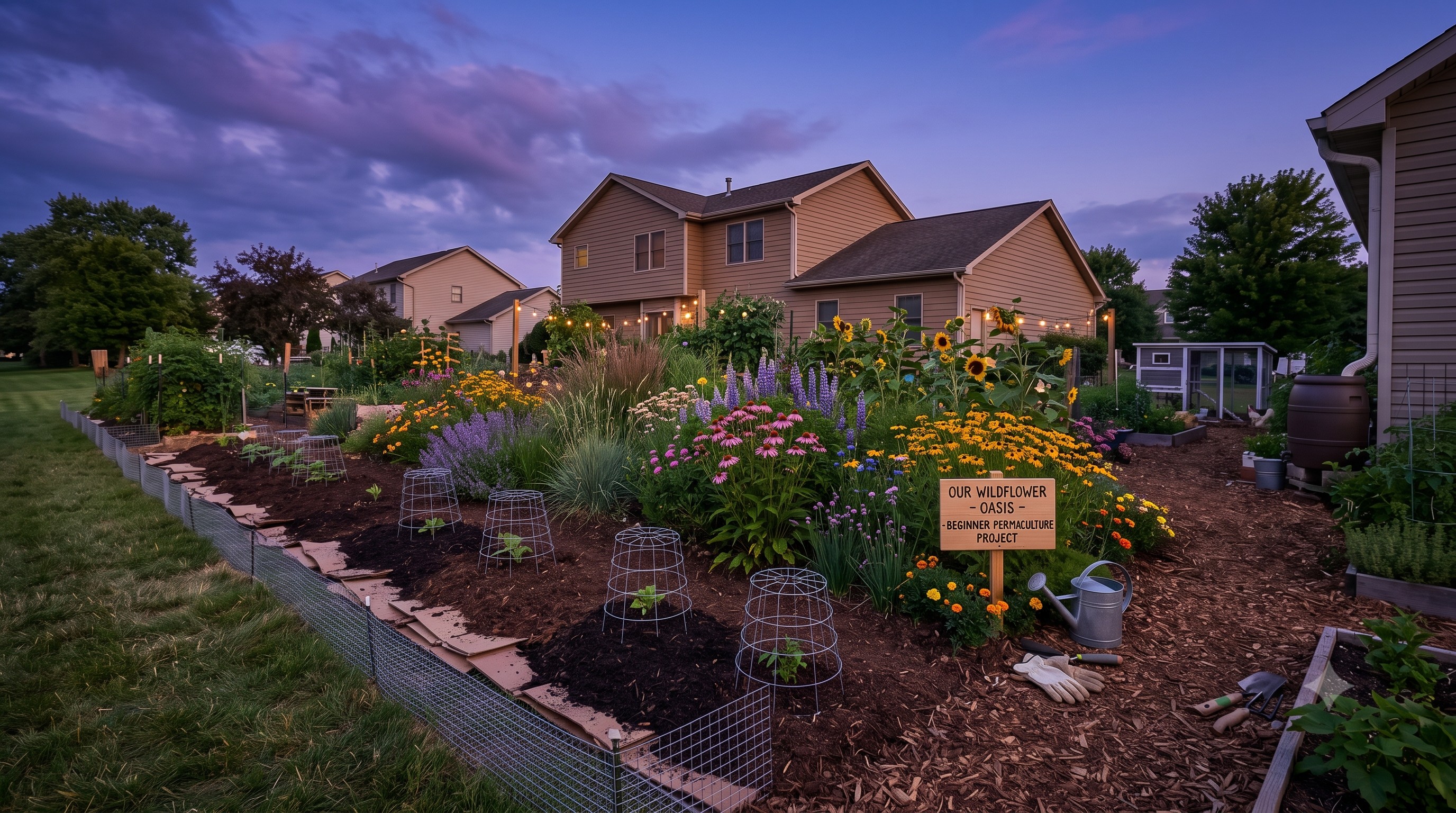
🌼 The Curious Beginner's Guide to Backyard Permaculture: A Wildlife-Resistant Wildflower Oasis
Serious Courses! Let's be honest for a second. Most of us look at our yards and see a massive to-do list. We mow, we weed, we spray, and we fight an endless, losing battle against the local wildlife. I'll admit it: I am not a master gardener. Recently, I optimistically planted a beautiful patch of wildflowers on my acre of land, only to discover I had inadvertently opened a 24/7 complimentary salad bar for the local rabbit population. They ate everything.
But instead of buying chemicals or throwing in the towel, I got curious. That curiosity led me to permaculture. If that word sounds like it requires an agricultural science degree, don't worry. Permaculture is actually a simple idea: it's a design system where we mimic natural ecosystems so nature does the heavy lifting for us. Instead of fighting nature, we collaborate with it. And you don't need a farm to do it — your suburban backyard is the perfect place to start.
Here's how to take a common weekend project — planting a gorgeous wildflower garden — and use basic permaculture principles to make it seriously resistant to rabbits, groundhogs, and deer. (I'll be honest with you up front: nothing is 100% critter-proof. But stack enough smart defenses together and the local wildlife will decide your neighbor's hostas are a much easier meal.)
What Is Permaculture, Anyway?
Before we dig in (or rather, don't dig in — more on that in a minute), let's demystify the concept. Traditional gardening runs on constant human inputs: you water, you fertilize, you protect the plants manually, forever. Permaculture looks at how a natural forest works. Nobody fertilizes a forest. Nobody waters it. Yet it thrives. By positioning the right plants and elements next to each other, we create a system that increasingly runs itself.
Permaculture Principle #1: Observe and Interact. Instead of rushing out to change your yard overnight, stop and watch. Where does the water flow when it rains? Where does the sun hit, and for how long? And most importantly — which furry neighborhood critters are frequenting your yard, and what paths do they take? Fifteen minutes on the porch with a coffee is legitimate garden work. Really.
Watch: Huw Richards gives a six-minute crash course on what permaculture actually is — the perfect place to start.
Watch: Wondering what to do first on your own patch of land? These are the five opening moves, whether you have an eighth of an acre or 180.
Step 0: Stack the Deck with the Right Wildflowers
Here's the cheapest defense of all, and the one most beginners skip: choose wildflowers the wildlife doesn't want in the first place. Deer and rabbits generally avoid plants that are aromatic, fuzzy, or bitter. Happily, that list includes some of the showiest natives around: yarrow, black-eyed Susan, purple coneflower, bee balm, milkweed, blanket flower, and lupine. A seed mix built around these species means your defenses only have to protect the vulnerable seedling stage — not wage a permanent war.
This is permaculture thinking in a nutshell: solve the problem in the design phase, before it ever becomes a problem in the maintenance phase.
Step 1: Prepare the Bed (The No-Dig "Lasagna" Method)
Traditional gardening tells you to rent a heavy tiller, tear up the grass, and break your back. Permaculture says: let the grass rot in place and feed the soil. The technique is called sheet mulching. Lay thick layers of plain corrugated cardboard right over the grass (remove every scrap of plastic tape, and skip glossy or coated boxes), soak it thoroughly to kickstart decomposition, then layer compost and wood chips on top. The cardboard smothers the grass and weeds, traps moisture, and breaks down into rich, spongy soil — all without disturbing the microbial life underground. You can build a brand-new wildflower bed this way in a single afternoon, no tiller required.
Watch: Charles Dowding — the global authority on no-dig gardening — walks through his step-by-step beginner's method for starting a new bed with cardboard and compost.
Step 2: Design the Defense System (The Big Three)
Now for the fun part: outsmarting the suburban safari. Even resistant wildflowers are tender and tasty as seedlings, so we layer physical barriers and plant-based deterrents against each of the three main offenders.
1. The Rabbit Defense: Cloches and Scent Confusion
Rabbits are lazy foragers — they want maximum calories for minimum effort. Use that against them. The immediate fix: make DIY chicken-wire cloches (bell-shaped domes) and place them directly over young wildflowers, pinned down with landscape staples. This keeps bunny teeth away during the small, vulnerable stage — which is exactly when rabbits do most of their damage.
The long-term fix: surround the patch with a defensive ring of intensely aromatic plants: chives, garlic, lavender, and other alliums. The strong scents mask the smell of the tender plants inside and make the whole area less appealing. (You'll often see marigolds recommended too. Plant them because they're cheerful — but don't count on them alone; plenty of rabbits happily eat marigolds.)
2. The Deer Defense: The T-Post Citadel
Deer browse high and love tender buds, and here's the catch: a motivated deer can clear an 8-foot fence. Fencing your whole yard that tall is expensive and ugly. The permaculture move is to exploit a quirk of deer psychology instead: deer won't jump into a small, enclosed space they can't see a clear exit from.
The physical barrier: around your wildflower patch (or any young tree near it), drive in heavy-duty metal T-posts and wrap a 5-to-6-foot ring of welded wire fencing around them. Kept small and circular, the enclosure reads as a trap to a deer, and they'll leave it alone — even though they could technically jump it. The plant guild: interplant and border your wildflowers with alliums (flowering onions), Russian sage, and yarrow. Deer dislike the texture, scent, and taste, adding one more "not worth it" signal.
Watch: The Rusted Garden's Gary Pilarchik shows how simple physical barriers protect plants from rabbits, birds, and deer — no chemicals required.
Watch: A simple, real-world deer-proof garden setup you can copy this weekend.
3. The Groundhog Defense: The L-Shaped Apron
Groundhogs are elite tunnelers. Put up a standard fence and they'll simply dig under it. But you don't need to trench four feet down — you need geometry. The trick: use an L-shaped apron fence. Run your fencing down to the soil surface, then bend the bottom 12 to 18 inches of wire outward, flat along the ground, and pin it down. When a groundhog walks up to the fence to dig, it's standing directly on top of the mesh. It digs down, hits wire, gets confused, and gives up. Within a few weeks the grass grows right up through the apron and hides it completely.
One more thing: groundhogs can climb, too. Leave the top 12 inches or so of your fence unattached to the posts so it wobbles — a groundhog that tries to climb a floppy fence top gets bent backward and bails out.
Watch: The step-by-step build of a fence that stops rabbits, woodchucks, and more — with the no-digging L-apron trick in action.
Summary: Your Weekend Action Plan
Permaculture is a journey of small wins. You don't have to transform your entire acre this weekend. Pick this one wildflower project, embrace your inner curious beginner, and take action.
[ ] Locate your spot: pick a sunny area close to your house — what
    permaculture calls "Zone 1," the space you walk past every day —
    so monitoring it takes zero extra effort.
[ ] Choose resistant species: build your seed mix around yarrow,
    coneflower, black-eyed Susan, bee balm, and other plants deer
    and rabbits avoid.
[ ] Source your cardboard: gather large, plain (unwaxed, non-glossy)
    boxes and strip off all plastic tape.
[ ] Sheet mulch: lay the cardboard, soak it, and cover it with
    compost and wood chips.
[ ] Plant and protect: sow your seeds or starters, place chicken-wire
    cloches over anything tender, and plant a ring of chives or
    alliums around the border.
[ ] Observe: grab a coffee, sit on the porch, and watch how the local
    wildlife reacts to your new design. That's Principle #1 in action.
By shifting your mindset from "fighting nature" to "designing with nature," gardening stops being a chore and becomes a fascinating experiment. Start small, stack your defenses, and build something beautiful.
Footnotes: Further Watching
Want to go deeper? These are worth your time:
- How I Turned My Yard Into a Food Paradise — Andrew Millison (founder of Oregon State University's permaculture program) tours his own suburban-lot transformation.
- 11 Truly Deer Resistant Native Plants (That Deer Actually Avoid) — Growit Buildit's field-tested list, a great companion to Step 0.
- No Dig Gardening Method: DIY How To Create a New Flower Bed with Sheet Mulching — an alternate walkthrough of the lasagna layering process.
- I Found a Better Alternative to Cardboard for Sheet Mulching — The Permaculture Consultant, for when you can't source enough clean cardboard.
You can explore the full list of permaculture videos and courses here:
Permaculture Courses and VideosKnow a great permaculture or critter-proofing video that should be included? Send it our way at support@seriousmindware.com — we'd love to check it out.
More From the Blog
- ScienceFrom Read-Only to Programmable: Genetics, Epigenetics, and the Age of Gene EditingOctober 9, 2026
Your DNA is the source code, epigenetics is the runtime that decides what runs, and CRISPR is the first tool with write access. A plain-language tutorial on the genome, epigenetics, stem cells, aging reversal, and gene editing, with a video for every concept.
- EconomicsHow Good Is the Economy, Really? What 27 Official Indicators SayOctober 4, 2026
Stocks are up 15%, but real pay is slipping 0.3%. Unemployment is low, but gas, interest rates, and thin savings tell a harsher story. Here is a data-first tour through the numbers driving the headline debate—no spin, no political commentary.
- EconomicsThe $40 Trillion Question: How the U.S. Debt Squeeze Unfolds — and What We Can Do About ItSeptember 27, 2026
The U.S. national debt just crossed $40 trillion, and interest now costs about $1 trillion a year. It won't end in a sudden default — it ends in a slow fiscal squeeze. Here's the timeline, the five paths nations use to escape heavy debt, the reforms with the most leverage, and what it all means for your portfolio.
- EconomicsThe Global Economic Engine: Rebalancing Capitalism and Socialism in the New Space RaceSeptember 12, 2026
Capitalism and socialism aren't opposites at war — they're two halves of the same economic engine, one generating thrust and one keeping it from overheating. Here's how that balance plays out in the US and Chinese economies, stress-tested by the live race to the lunar south pole.
- Economics⚡ Why Everyday Ratepayers Are Subsidizing Tech's Power BoomAugust 2, 2026
Since 2020, U.S. electric bills have jumped more than a third — and AI data centers and EV charging are two of the biggest reasons why. This is a firsthand account of what it actually costs to opt out with home solar and batteries, how utility accounting lets Big Tech and EV charging networks shift grid-upgrade bills onto ordinary ratepayers, and finally why the "Bring Your Own Clean Power" policy is the best way out of this rate surge.
- Ecology⚙️ Operating the Earth Engine: What Systems Engineering Teaches Us About Keeping a Planet HabitableJuly 26, 2026
Less than two weeks ago, the sun over the East Coast was a dull orange disc behind Canadian wildfire smoke — not a weather event so much as a telemetry reading. Earth behaves like a machine with feedback loops, operating limits, and control lags. Seven of its nine safety margins are now outside spec. Here's how to read the dashboard, and where we actually have our hands on the controls.
- Ecology🏜️ Green Energy vs. Green Earth: Finding the "Happy Percentage" for the World's DesertsJuly 23, 2026
AI's power hunger is pushing us toward paving the desert with solar panels. But a third of the planet is meant to be arid — and the world's largest desert quietly feeds the world's largest rainforest. A look at deserts, dust, and the 1.2% that could power everything without wrecking the rest.
- Economics🪙 Beyond Currency: How Society Functions When Money Becomes ObsoleteJuly 7, 2026
Could humanity outgrow money entirely? An attempt at a skeptic-proof tour of the three pillars of a post-currency economy — the tech, the limits, the motivation — and what you can start building today.
- Artificial Intelligence🤖 Silicon Safety Nets: Why Tech Billionaires Love UBI — and Why Economists Are WorriedJuly 1, 2026
AI is now the #1 stated reason for layoffs, and Silicon Valley wants to send you a check. Inside the 2026 battle between the UBI dreamers and the inflation hawks.
- RocketsThe Weight of the Worlds: What Happens When We Drag the Asteroid Belt Home?June 25, 2026
Every sci-fi movie about space mining ends exactly where the real nightmare begins.
- CryptocurrencyQuantum vs. Crypto: Who Wins the Race for Your Digital Wealth?June 22, 2026
Google's quantum whitepaper compressed the timeline — here's what breaks, what holds, which coins are most exposed, and why today's slump is macro, not quantum.
- AzureWhat’s New in Microsoft Azure (Summer 2026)June 21, 2026
A SeriousCourses deep dive into the most important Azure updates shaping the cloud right now.
- Artificial Intelligence🚀 The Agentic Shift: Navigating the Top AI ModelsJune 15, 2026
GPT-5, Claude, Gemini, Grok — the old way of judging AI is dead. Here's a clear-eyed guide to the new league of specialized titans.
- Artificial Intelligence🌌 The AI Model Landscape in Mid-2026: A Guide to the FrontierJune 11, 2026
Claude, GPT-5.5, Gemini, Grok, DeepSeek — a clear-eyed guide to what each frontier model does best in mid-2026.
- Artificial Intelligence🌌 Coding in the Age of AI: A Brave New CurriculumFebruary 28, 2026
How AI is rewriting what it means to learn to code — a brave new curriculum for programming alongside intelligent tools.
- ProgrammingNew Programmer Guide for 2026 — Level Up Your Skills with Serious CoursesFebruary 26, 2026
Just starting out in code? A practical roadmap of skills, languages, and resources to level up as a new programmer in 2026.
- Quantum Computing🌌 Charting the Quantum Frontier: A Serious Courses GuideFebruary 25, 2026
Qubits, superposition, and the strange machinery of quantum computing — a clear-eyed guide to one of computing's most exciting frontiers.
- Artificial Reality🌌 Artificial, Augmented, Mixed, and Virtual RealityFebruary 24, 2026
AR, MR, and VR explained — the technologies blending the digital and physical worlds, and where to start exploring them.
- Cyber Security🕶️ Cyber Security & Ethical Hacking: Enter the Digital ArenaFebruary 16, 2026
The art of digital defense — encryption, vigilance, and ethical hacking. A curated entry point into the world of cyber security.
- Cryptocurrency🌐 Cryptocurrency, Blockchain & Web3: A Journey BeginsFebruary 15, 2026
A guided tour of digital currencies, blockchains, and the decentralized promise of Web3 — from high-level overviews to the mechanics underneath.
- Games🎮 Game Development: Your Indie Journey Starts HereFebruary 14, 2026
Godot, Unity, or Unreal? A beginner-friendly guide to choosing your engine and building your first indie game from concept to creation.
- RocketsRocket & Space Propulsion TechnologyFebruary 13, 2026
Rockets, in-space propulsion, and a little warp-drive theory — the systems we can build today and the visionary concepts that may shape tomorrow.
- AutomotivesAutomotive TechnologyFebruary 11, 2026
From combustion to EVs and autonomous systems — a curated tour through the technology reshaping how we move.
- AWSAmazon Web Services (AWS): Your 2026 Springboard with Serious CoursesFebruary 9, 2026
A clean, high-level introduction to the world's most widely adopted cloud platform — core services, certifications, and where to begin.
- AzureMicrosoft Azure: Your 2026 Launchpad with Serious CoursesFebruary 8, 2026
Your starting point for Microsoft Azure: why it stands out, the certification paths worth chasing, and a curated launchpad into the platform.
- GoogleGoogle Cloud: A Fresh 2026 Guide from Serious CoursesFebruary 7, 2026
The often-overlooked cloud that powers a huge share of enterprise infrastructure — where Google Cloud leads, why it matters, and how to start.
Contact Us
Questions or feedback about anything? We'd love to hear from you.
You can reach us at: support@seriousmindware.com
Comments
No comments yet.