Online Courses in AI, Cybersecurity, Mathematics & More
Welcome to Serious Courses!
Your gateway to a Celestial Library of Learning. Here, each course is a star in a vast constellation of knowledge, handpicked for seekers of mastery. Some glimmer behind paywalls, others shine freely in the open sky—but all are portals to deeper understanding. Know of a course that belongs among these stars? Whisper it to us at support@seriousmindware.com. The archive expands with every voice.
From the Serious Courses blog.
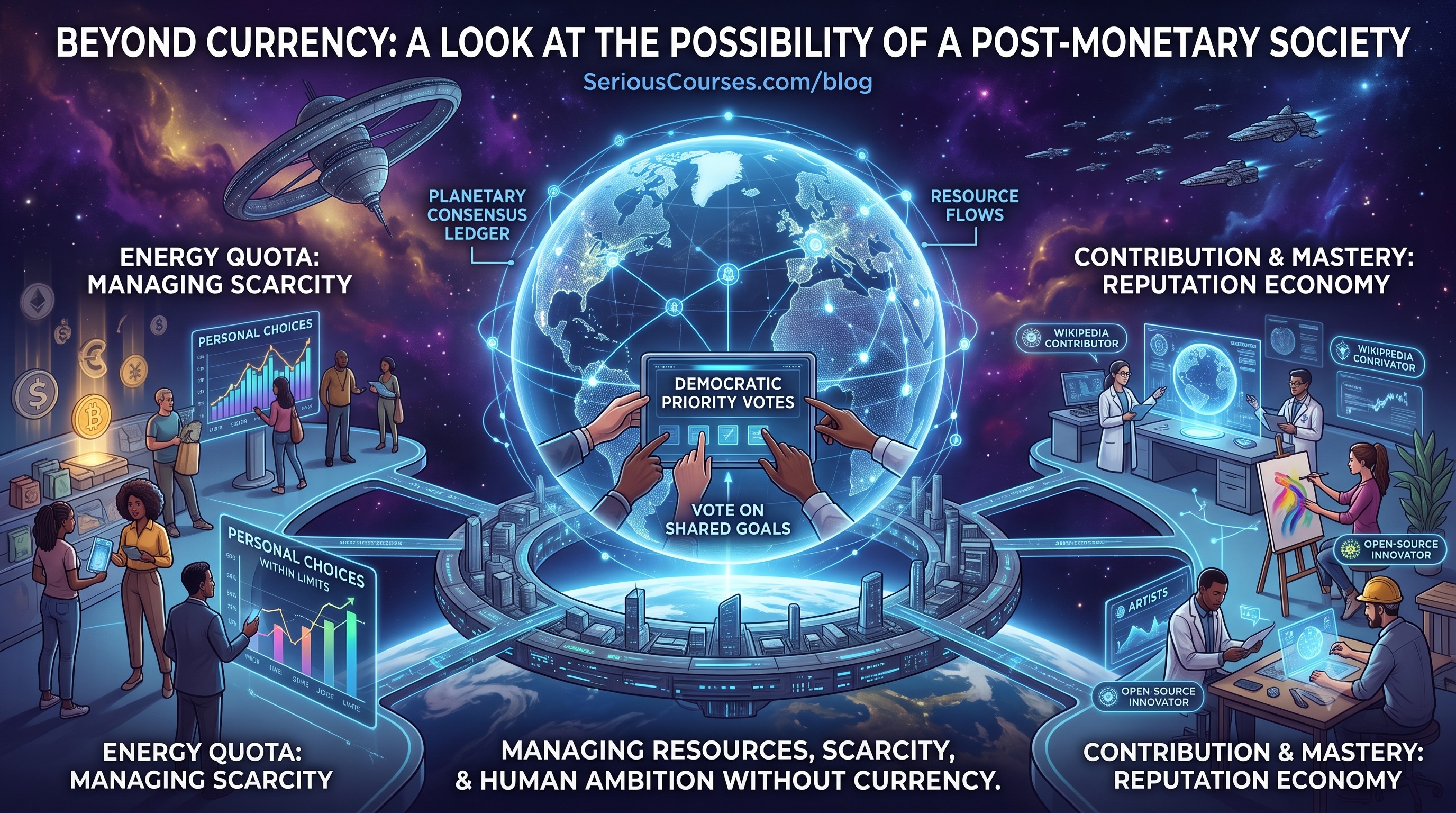
🪙 Beyond Currency: How Society Functions When Money Becomes Obsolete
Serious Courses! Imagine waking up tomorrow in a world where money simply doesn't exist. No cash, no credit cards, no digital banking apps, and no stock markets.
For most of us, this thought experiment triggers immediate anxiety. How would we buy groceries? Who would build the houses? Wouldn't society instantly collapse into a chaotic, primitive barter system where you have to trade a chicken for a dental check-up?
Historically, humanity has relied on currency as a tool to solve a fundamental problem: how to manage scarcity. But what if technology has advanced to the point where we can outgrow the training wheels of money? What if we could build an economy inspired by the ideals of Star Trek — a world driven not by the pursuit of wealth, but by the pursuit of human potential?
Watch: How the Federation actually functions without money — a tour of Earth's economy in the Star Trek universe.

Here's the thing, though: this idea has been tried before, badly, and the failures were catastrophic. So this post isn't going to hand-wave past the hard objections. It's going to meet them head-on. A post-monetary economy needs three practical, high-tech pillars to replace the function of the coin — and each pillar has to survive its strongest critic.
Pillar 1: The Open-Source Resource Tracker (The Tech)
When people think of a moneyless economy, they often fear a faceless, Orwellian AI making all the decisions behind closed doors. But a viable future economy requires absolute transparency.
Instead of currency, an advanced society would use a decentralized, open-source distributed ledger — the same basic architecture behind modern blockchain technology. However, instead of tracking financial tokens for trading, this ledger acts as a "Digital Twin" of the Earth, using a network of automated sensors to monitor planetary health and resource availability in real time.
HUMAN DEMOCRACY   -->  Sets goals (e.g., Green Energy)
        |
        v
OPEN-SOURCE AI    -->  Computes logistics & material costs
        |
        v
PLANETARY SENSORS -->  Tracks raw materials & ecosystems
To ensure human agency, the system divides labor cleanly. The AI acts as the "super-accountant," computing physical realities: if we build a new transit system here, we will use X amount of steel, impacting our infrastructure budget by Y percent. Because the code is completely open-source, any citizen or scientist can audit the logic — there are no hidden corporate algorithms. And citizens vote directly on overarching societal goals: if the public votes to prioritize deep-space exploration over luxury expansions, the system recalibrates to allocate resources toward that goal.
The Skeptic's Turn: The Ghost of Hayek
Now for the objection every economist reading this is already shouting: the economic calculation problem.
In the 1920s and 30s, economists Ludwig von Mises and Friedrich Hayek argued that planned economies must fail for a reason deeper than corruption or laziness. Prices, they showed, aren't just numbers — they're a compression algorithm. Every price silently aggregates the dispersed, private knowledge of millions of people: which factory is running hot, which farmer's crop failed, which teenager suddenly wants a new kind of shoe. No central planner can gather that knowledge, because most of it is tacit — people don't even know they have it until a price moves and they react. The Soviet Union didn't collapse because its planners were stupid; it collapsed because the problem they were assigned was mathematically unwinnable with the tools they had.
Watch: The classic case against everything this post proposes — Hayek's socialist calculation problem, explained by Marginal Revolution University.
Any honest post-monetary proposal has to answer Hayek, so here is the answer — in two parts.
First, the technology gap that made calculation impossible in 1935 is closing. Hayek's planners had paper forms and telephones; a planetary sensor network has real-time telemetry on supply. And on the demand side, we already live inside a working prototype: every time you tap "order" on an e-commerce app, you're broadcasting a precise, timestamped preference signal that logistics algorithms act on within seconds — no price negotiation required. Modern supply chains are, internally, planned economies of staggering scale. The world's largest retailers don't run internal markets between their warehouses; they run algorithms.
Second — and this is the part utopians usually skip — the system shouldn't even try to centrally plan everything. Hayek was right that micro-preferences can't be aggregated from the top down. So the ledger plans only what is genuinely collective: energy grids, raw material extraction, transit, ecological limits. Individual consumption stays radically decentralized — you signal what you want, directly, and the system treats those signals exactly the way prices once worked, as distributed information. The goal isn't to replace the market's information function. It's to replace the market's gatekeeping function: the part where your access to the results depends on your bank balance.
One more honest caveat: "the AI just calculates, humans decide the values" is a cleaner line than reality allows. Every optimization objective embeds value judgments — how much is a wetland worth against a hospital? That's precisely why the code must be open-source and the objectives publicly ratified. The point of transparency isn't that the AI is value-free. It's that its values are everyone's to inspect and change.
Pillar 2: The Personal Energy Budget (The Limits)
The word "rationing" has terrible PR. It conjures bleak images of wartime breadlines. But in a post-monetary world, we must replace artificial pricing with thermodynamic reality. Instead of rationing, we introduce the Personal Energy Budget.
Your baseline survival needs — housing, healthcare, standard nutrition — cost zero; they are built directly into automated public infrastructure. Your budget covers discretionary lifestyle choices. A replicated cup of coffee costs next to nothing against your budget. A suborbital flight across the globe requires a massive, measurable expenditure of planetary energy — so it takes a significant chunk of your monthly allotment. The system won't ban you from going. Physics will just ask you to choose.
| Feature | Legacy Financial System | The Energy Budget System |
|---|---|---|
| Driven by | Market speculation and profit | Real-time energy and resource costs |
| Handling scarcity | Prices skyrocket; only the wealthy afford it | Energy cost adjusts; citizens prioritize choices |
| Accumulation | Wealth can be hoarded and invested for power | Credits are use-it-or-lose-it; hoarding is impossible |
The Skeptic's Turn: "Congratulations, You've Reinvented Money"
Let's just say it: yes, an energy credit is technically a currency. It's a unit of account and a medium of allocation. Anyone who tells you their post-money system has no currency-like object anywhere in it is selling you something.
But the claim was never that we'd eliminate accounting — it's that we'd eliminate what money became. Compare the properties. Money can be hoarded across generations; energy credits expire. Money can be lent at interest and compounded into dynastic power; energy credits can't reproduce themselves. Money's supply is governed by central banks and speculation; the energy budget is governed by how much clean generation the planet actually has. We're not abolishing the measuring stick. We're abolishing the casino built on top of it.
Two harder objections deserve straight answers. First, the transferability dilemma. If credits are non-transferable, we block a harmless win-win: the homebody who'd happily give an unused flight allotment to a friend who travels. But the moment credits become freely tradeable, markets — and accumulation, and inequality — quietly reassemble themselves. There's no perfect answer, only a design trade-off: limited, capped, non-compounding transfers (think gift allowances, not investment vehicles) capture most of the win-wins while structurally preventing anyone from becoming an energy baron. This is a dial that society tunes democratically, not a law of nature.
Second, the positional goods problem. Energy budgets allocate things that can be manufactured. They cannot allocate the apartment with the ocean view, because there is exactly one of it and no amount of abundance creates a second front row. Land and location are inherently scarce, and this — not coffee or electronics — is where post-scarcity thinking usually goes to die. Honest answers exist, but they're social rather than technical: rotation and time-sharing of unique locations, lottery systems, and community stewardship of prime land rather than permanent private title. Some cultures have run commons like this for centuries. It will feel strange to people raised on freehold property, which is exactly why the transition (below) takes generations, not years.
Even in Star Trek: Voyager, when the crew was cut off from the Federation, they instituted "replicator rations." Why? Because physics always wins.
Pillar 3: The Reputation Economy (The Motivation)
If survival is guaranteed and you can't get rich, why would anyone work? The answer lies in evolutionary psychology. Humans are not solely driven by money; we are driven by respect, mastery, belonging, and prestige. In a gift economy, status isn't determined by what you hoard, but by what you give away. The person who contributes the most holds the highest social capital.
Watch: Theorist Charles Eisenstein on the core principle of a gift economy — the more you give, the richer you are.
The modern proof — with an asterisk. Wikipedia is written and curated by brilliant minds donating millions of hours for zero dollars. The internet runs on Linux, built by programmers competing fiercely for the prestige of having their code accepted. But let's be honest about the asterisk: today, most Linux kernel development is done by salaried engineers at companies like Intel, Red Hat, and Google, and Wikipedia editors have day jobs. What these projects prove is not that money is unnecessary — it's that when survival is already covered, prestige and mastery are sufficient to motivate world-class creative work. That's exactly the condition Pillar 2 creates for everyone.
Watch: The research behind why people do world-class work without a paycheck — Dan Pink's famous talk on autonomy, mastery, and purpose, animated by the RSA.
The Skeptic's Turn: Who Cleans the Sewers?
Prestige motivates people to write encyclopedias and compose symphonies. It does not motivate anyone to work the 3 a.m. shift cleaning a sewage treatment plant. So who does? Nobody — and that's the design requirement, not a loophole. The unpleasant, dangerous, repetitive jobs are precisely the ones automation must eliminate first, and this ordering is non-negotiable. A society is not ready to drop currency until the drudge work is done by machines. If your robot fleet can't yet handle sanitation, eldercare logistics, and mining, you are still in the transition phase — full stop. For the shrinking band of unpleasant work that resists automation longest, the honest interim answer is compensation in the only remaining scarce good: outsized energy budgets and first-priority access. The dirty jobs, for once, pay best.
And one more skeptic's point worth conceding: reputation can be hoarded too. Status economies have their own rich-get-richer dynamics — sociologists call it the Matthew effect — and their own oligarchs. A reputation economy needs anti-accumulation design just like the energy budget does: prestige that decays without ongoing contribution, domain-specific standing (being a legendary surgeon shouldn't make your opinion on transit policy count double), and no mechanism for converting reputation into control over resources. We're not swapping one aristocracy for another. We're making all aristocracies structurally impossible.
In Star Trek, why does Captain Sisko's father run a physical Creole restaurant in New Orleans when anyone can replicate gumbo for free? Because he loves the craft, loves the mastery, and thrives on the immediate human reward of making people happy. In a reputation economy, humans don't stop competing — they elevate the game. We stop competing to see who can hoard the most paper, and start competing to see who can be the most useful.
The Big Question: How Do We Actually Transition?
This is where the skepticism rightly rolls in. History is littered with failed, centralized attempts to rewrite economics, most of which devolved into authoritarian nightmares. And there's a second obstacle the utopians underestimate: money isn't just a tool people use — it's a source of power people hold, and power does not starve quietly. Any realistic transition has to route around entrenched interests rather than through them. That means no overnight revolution. We slide into it gradually, over generations.
Phase 1: Universal Basic Infrastructure (UBI 2.0)
Instead of cash handouts (which keep us trapped in the currency loop), communities focus on automating survival: green energy grids, automated vertical farming, open-source AI diagnostics driving the cost of food, energy, and healthcare toward zero. But note the honest exception: housing. Automation can make construction cheap; it cannot make land abundant, because housing cost is mostly location, and location is positional. This is why Phase 1 must include social innovations alongside technical ones — community land trusts that take land off the speculative market permanently, and massive expansion of well-designed public housing. The cost of shelter can approach zero. The market price of the ocean view never will, and pretending otherwise is how this vision loses credibility. Once survival is decoupled from employment, the survival-panic underlying our currency addiction disappears.
Phase 2: The Hybrid "Dual-Tab" Economy
For a generation, the legacy currency market and the algorithmic resource ledger run side by side. You might still use traditional money for vintage antiques or artisan crafts, while heavy industry, public transit, and green energy shift entirely to the resource tracker. As automation drives the production cost of everyday goods toward zero, those goods naturally migrate from the currency market into the open-source system. Money doesn't get banned; it gradually loses its jobs, one sector at a time.
Phase 3: The Psychological Shift
As a new generation grows up never knowing the fear of rent, poverty, or medical debt, ambition itself gets rewired. Accumulating vast physical wealth begins to look bizarre — as nonsensical as hoarding all the oxygen in a room. This is the phase where money's last job — signaling status and power — finally gets outcompeted by the reputation economy. Human ambition diverts toward scientific achievement, artistic mastery, and civic contribution.
What You Can Do Before the Transition
If this takes generations, is there anything actionable now? More than you'd think. Every pillar above has a real-world embryo you can join, build, or advocate for today.
Build the ledger's ancestors. The EU is already rolling out Digital Product Passports — open records of what materials are in a product and where they came from. Open-source resource accounting, open climate data, and right-to-repair legislation are the primitive sensor network of Pillar 1. Support them; contribute to them.
Practice the gift economy. Contribute to open-source software, Wikipedia, OpenStreetMap, or citizen science. These aren't just hobbies — they're live experiments in reputation-driven production, and every contribution strengthens the proof of concept.
Join the library economy. Tool libraries, seed libraries, repair cafés, and community makerspaces are small-scale access-over-ownership systems operating inside capitalism right now. They train the cultural muscle that Pillar 2 requires.
Advocate for the land fix. Community land trusts exist today in hundreds of cities and directly attack the positional-goods problem — the hardest problem in this entire post. They are arguably the single highest-leverage transition institution available.
Watch: PBS on how community land trusts are expanding to keep housing permanently affordable — the land fix, already working today.
Push for universal basic services. Where the UBI debate argues about cash, universal basic services — free transit, healthcare, connectivity — builds Phase 1 infrastructure directly, one sector at a time. We covered that debate in depth here:
Silicon Safety Nets: Why Tech Billionaires Love UBI — and Why Economists Are WorriedNone of this requires waiting for permission, a revolution, or a replicator. The transition doesn't begin in a generation. It began already — quietly, in a tool library near you.
Summary: Leaving the Training Wheels Behind
Moving away from currency isn't about entering a restrictive, state-controlled regime. It's about building a digital bridge of data and automation so we can finally grow out of a system based on survival of the richest.
The skeptics are right about the hard parts: calculation is genuinely hard, land is genuinely scarce, drudge work genuinely needs doing, and any status system can breed new elites. A serious post-monetary vision doesn't wave those away — it designs for them. And once it does, the prize is worth the patience of generations: a society where human worth is measured by what you give to the world, rather than what you take from it.
Going Deeper: Footnotes for the Curious
These ideas have decades of history behind them. If this post sparked something, here are longer explorations of each thread — including the controversial ones, presented with eyes open.
- Peter Joseph's TEDx introduction to a resource-based economy — the most prominent activist articulation of Pillar 1's core idea, from the founder of the Zeitgeist Movement (a lineage that comes with its own controversies; judge the argument on its merits)
- The Gift Economy: A Resilient Alternative to Consumer Culture — a deeper dive into Pillar 3
- Power to the People — the civil-rights-era origins of community land trusts, in depth
Explore the full Economics course library here:
Economics Courses and VideosKnow of a great video on post-scarcity economics, gift economies, or the future of money? Send it our way at support@seriousmindware.com — we'll add it to the collection.
More From the Blog
- ScienceFrom Read-Only to Programmable: Genetics, Epigenetics, and the Age of Gene EditingOctober 9, 2026
Your DNA is the source code, epigenetics is the runtime that decides what runs, and CRISPR is the first tool with write access. A plain-language tutorial on the genome, epigenetics, stem cells, aging reversal, and gene editing, with a video for every concept.
- EconomicsHow Good Is the Economy, Really? What 27 Official Indicators SayOctober 4, 2026
Stocks are up 15%, but real pay is slipping 0.3%. Unemployment is low, but gas, interest rates, and thin savings tell a harsher story. Here is a data-first tour through the numbers driving the headline debate—no spin, no political commentary.
- EconomicsThe $40 Trillion Question: How the U.S. Debt Squeeze Unfolds — and What We Can Do About ItSeptember 27, 2026
The U.S. national debt just crossed $40 trillion, and interest now costs about $1 trillion a year. It won't end in a sudden default — it ends in a slow fiscal squeeze. Here's the timeline, the five paths nations use to escape heavy debt, the reforms with the most leverage, and what it all means for your portfolio.
- EconomicsThe Global Economic Engine: Rebalancing Capitalism and Socialism in the New Space RaceSeptember 12, 2026
Capitalism and socialism aren't opposites at war — they're two halves of the same economic engine, one generating thrust and one keeping it from overheating. Here's how that balance plays out in the US and Chinese economies, stress-tested by the live race to the lunar south pole.
- Economics⚡ Why Everyday Ratepayers Are Subsidizing Tech's Power BoomAugust 2, 2026
Since 2020, U.S. electric bills have jumped more than a third — and AI data centers and EV charging are two of the biggest reasons why. This is a firsthand account of what it actually costs to opt out with home solar and batteries, how utility accounting lets Big Tech and EV charging networks shift grid-upgrade bills onto ordinary ratepayers, and finally why the "Bring Your Own Clean Power" policy is the best way out of this rate surge.
- Ecology⚙️ Operating the Earth Engine: What Systems Engineering Teaches Us About Keeping a Planet HabitableJuly 26, 2026
Less than two weeks ago, the sun over the East Coast was a dull orange disc behind Canadian wildfire smoke — not a weather event so much as a telemetry reading. Earth behaves like a machine with feedback loops, operating limits, and control lags. Seven of its nine safety margins are now outside spec. Here's how to read the dashboard, and where we actually have our hands on the controls.
- Ecology🏜️ Green Energy vs. Green Earth: Finding the "Happy Percentage" for the World's DesertsJuly 23, 2026
AI's power hunger is pushing us toward paving the desert with solar panels. But a third of the planet is meant to be arid — and the world's largest desert quietly feeds the world's largest rainforest. A look at deserts, dust, and the 1.2% that could power everything without wrecking the rest.
- Permaculture🌼 The Curious Beginner's Guide to Backyard Permaculture: A Wildlife-Resistant Wildflower OasisJuly 16, 2026
Rabbits ate my wildflowers, so I stopped fighting nature and started designing with it. No-dig beds, scent rings, deer psychology, and one very clever L-shaped fence.
- Artificial Intelligence🤖 Silicon Safety Nets: Why Tech Billionaires Love UBI — and Why Economists Are WorriedJuly 1, 2026
AI is now the #1 stated reason for layoffs, and Silicon Valley wants to send you a check. Inside the 2026 battle between the UBI dreamers and the inflation hawks.
- RocketsThe Weight of the Worlds: What Happens When We Drag the Asteroid Belt Home?June 25, 2026
Every sci-fi movie about space mining ends exactly where the real nightmare begins.
- CryptocurrencyQuantum vs. Crypto: Who Wins the Race for Your Digital Wealth?June 22, 2026
Google's quantum whitepaper compressed the timeline — here's what breaks, what holds, which coins are most exposed, and why today's slump is macro, not quantum.
- AzureWhat’s New in Microsoft Azure (Summer 2026)June 21, 2026
A SeriousCourses deep dive into the most important Azure updates shaping the cloud right now.
- Artificial Intelligence🚀 The Agentic Shift: Navigating the Top AI ModelsJune 15, 2026
GPT-5, Claude, Gemini, Grok — the old way of judging AI is dead. Here's a clear-eyed guide to the new league of specialized titans.
- Artificial Intelligence🌌 The AI Model Landscape in Mid-2026: A Guide to the FrontierJune 11, 2026
Claude, GPT-5.5, Gemini, Grok, DeepSeek — a clear-eyed guide to what each frontier model does best in mid-2026.
- Artificial Intelligence🌌 Coding in the Age of AI: A Brave New CurriculumFebruary 28, 2026
How AI is rewriting what it means to learn to code — a brave new curriculum for programming alongside intelligent tools.
- ProgrammingNew Programmer Guide for 2026 — Level Up Your Skills with Serious CoursesFebruary 26, 2026
Just starting out in code? A practical roadmap of skills, languages, and resources to level up as a new programmer in 2026.
- Quantum Computing🌌 Charting the Quantum Frontier: A Serious Courses GuideFebruary 25, 2026
Qubits, superposition, and the strange machinery of quantum computing — a clear-eyed guide to one of computing's most exciting frontiers.
- Artificial Reality🌌 Artificial, Augmented, Mixed, and Virtual RealityFebruary 24, 2026
AR, MR, and VR explained — the technologies blending the digital and physical worlds, and where to start exploring them.
- Cyber Security🕶️ Cyber Security & Ethical Hacking: Enter the Digital ArenaFebruary 16, 2026
The art of digital defense — encryption, vigilance, and ethical hacking. A curated entry point into the world of cyber security.
- Cryptocurrency🌐 Cryptocurrency, Blockchain & Web3: A Journey BeginsFebruary 15, 2026
A guided tour of digital currencies, blockchains, and the decentralized promise of Web3 — from high-level overviews to the mechanics underneath.
- Games🎮 Game Development: Your Indie Journey Starts HereFebruary 14, 2026
Godot, Unity, or Unreal? A beginner-friendly guide to choosing your engine and building your first indie game from concept to creation.
- RocketsRocket & Space Propulsion TechnologyFebruary 13, 2026
Rockets, in-space propulsion, and a little warp-drive theory — the systems we can build today and the visionary concepts that may shape tomorrow.
- AutomotivesAutomotive TechnologyFebruary 11, 2026
From combustion to EVs and autonomous systems — a curated tour through the technology reshaping how we move.
- AWSAmazon Web Services (AWS): Your 2026 Springboard with Serious CoursesFebruary 9, 2026
A clean, high-level introduction to the world's most widely adopted cloud platform — core services, certifications, and where to begin.
- AzureMicrosoft Azure: Your 2026 Launchpad with Serious CoursesFebruary 8, 2026
Your starting point for Microsoft Azure: why it stands out, the certification paths worth chasing, and a curated launchpad into the platform.
- GoogleGoogle Cloud: A Fresh 2026 Guide from Serious CoursesFebruary 7, 2026
The often-overlooked cloud that powers a huge share of enterprise infrastructure — where Google Cloud leads, why it matters, and how to start.
Contact Us
Questions or feedback about anything? We'd love to hear from you.
You can reach us at: support@seriousmindware.com
Comments
No comments yet.