Online Courses in AI, Cybersecurity, Mathematics & More
Welcome to Serious Courses!
Your gateway to a Celestial Library of Learning. Here, each course is a star in a vast constellation of knowledge, handpicked for seekers of mastery. Some glimmer behind paywalls, others shine freely in the open sky—but all are portals to deeper understanding. Know of a course that belongs among these stars? Whisper it to us at support@seriousmindware.com. The archive expands with every voice.
From the Serious Courses blog.
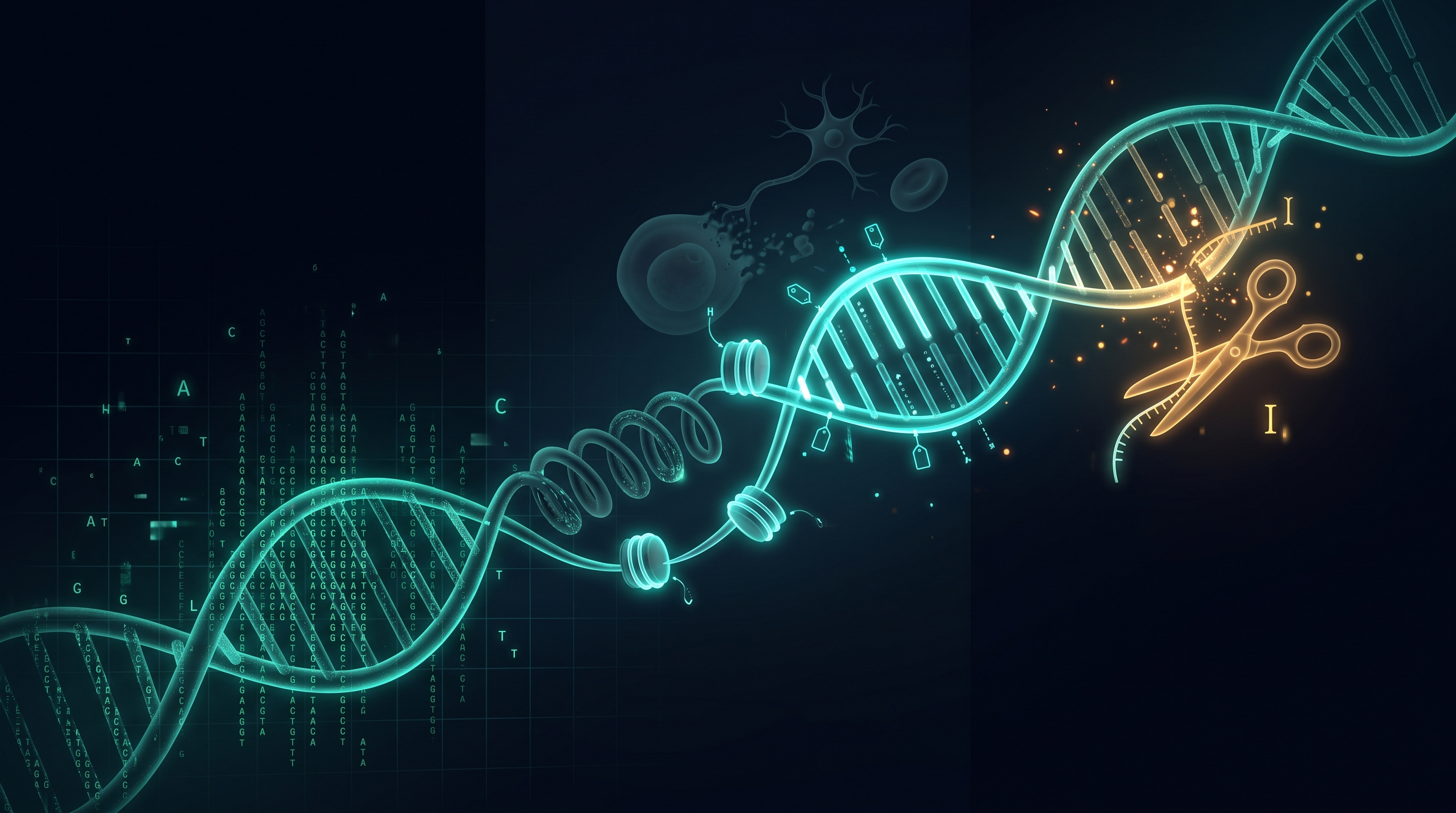
From Read-Only to Programmable: Genetics, Epigenetics, and the Age of Gene Editing
Serious Courses! Imagine being handed roughly 3.1 billion characters of legacy code—and then finding out that every cell in your body carries two copies of it. It was compiled the moment you were conceived, and for decades, textbook biology treated it as strictly read-only.
That source code is your genetics: the hardcoded baseline stored inside every cell. But code means nothing without an execution context. Sitting on top of your DNA is epigenetics, the runtime layer that decides which parts of the code actually run, in which cell, and when. And now tools like CRISPR are handing humanity something new: write access to the codebase itself.
The software metaphor isn’t perfect—biology is messier than any codebase, and we’ll flag the places where the analogy breaks—but it is a surprisingly good way to hold these ideas in your head. This post is a guided tutorial you can read straight through or dip into. Each section gives a plain-language walkthrough, a deeper dive for readers who want the technical detail, and a video.
The roadmap:
1. Genetics: The Source Code
Genetics is the study of heredity: how information is stored in cells and passed from parents to children. The storage medium is DNA (deoxyribonucleic acid), a very long molecule built from four chemical letters: A, C, G, and T (adenine, cytosine, guanine, and thymine).
The mental model:
How does code become a working program? In two steps. First, transcription: the cell copies a gene into a temporary working copy made of RNA. Second, translation: a molecular machine called the ribosome reads that RNA three letters at a time, each triplet (a codon) specifying one amino acid, and strings the amino acids into a chain that folds itself into a 3D protein. Shape is function, which is why a tiny typo can matter: sickle cell disease comes from a single-letter change in the hemoglobin gene that swaps one amino acid and makes the protein clump.
  DNA  --transcription-->  RNA  --translation-->  PROTEIN
(source)                (working copy)              (running app)
Watch: The Amoeba Sisters on how DNA, chromosomes, genes, and traits fit together.
2. A Tour of the Genome: What the Other 98% Does
Only about 1.5–2% of the human genome codes for proteins. For years the rest was dismissed as “junk DNA,” and that label has aged badly. The coding part is a small island in a large, busy ocean of sequence. How much of the ocean is truly functional is still debated—the 2012 ENCODE project’s claim that around 80% of the genome shows biochemical activity was criticized for confusing activity with function—but the regulatory portion is real, and it is large.
A field guide to the parts of the genome:
These categories overlap—many transposable elements sit inside introns, for example—so the percentages don’t add up to 100%. Sources: the Telomere-to-Telomere (T2T) Consortium’s complete human genome sequence (3.055 billion letters, published in 2022) and the original Human Genome Project analyses.
Here is what a typical gene looks like, and why “a gene is a function” is only half the story:
 [enhancer] ..... far away ..... [promoter][exon 1]-intron-[exon 2]-intron-[exon 3]
      |                                 ^
      +-- DNA loops in 3D to switch the promoter on

 After transcription, introns are spliced out and the exons joined.
 Different exon combinations can make different proteins from one gene.
This is why the regulatory genome matters so much. A large majority of the variants that genome-wide association studies tie to common diseases fall outside protein-coding genes, most likely because they alter when, where, or how strongly a gene is switched on rather than breaking the protein itself.
Watch: PBS Eons on why so-called junk DNA turns out to be more important than we once thought.
For the technically minded: reading the regulatory code is a machine-learning problem. AlphaFold predicts a protein’s 3D shape from its amino-acid sequence, which helps with variants that change a protein. The non-coding 98% needs a different kind of model. Google DeepMind’s AlphaGenome (published in Nature in January 2026) takes up to a million letters of DNA at once and predicts regulatory readouts such as gene expression, chromatin accessibility, and histone marks, so researchers can ask what a single-letter change in a non-coding region is likely to do. These are tools for deciding which experiments to run first, not substitutes for running them.
3. Epigenetics: The Runtime Environment
If every cell carries essentially the same DNA, why is a neuron nothing like a skin cell? (“Essentially” because red blood cells discard their nucleus, immune cells shuffle some of their antibody genes, and every cell picks up a few mutations over a lifetime. The recipe book is the same.) The answer is epigenetics, literally “on top of genetics”: chemical marks and structural changes that control which genes are accessible and active without changing a single letter of the sequence.
The mental model:
Watch: The Amoeba Sisters explain epigenetics and how cells control gene expression.
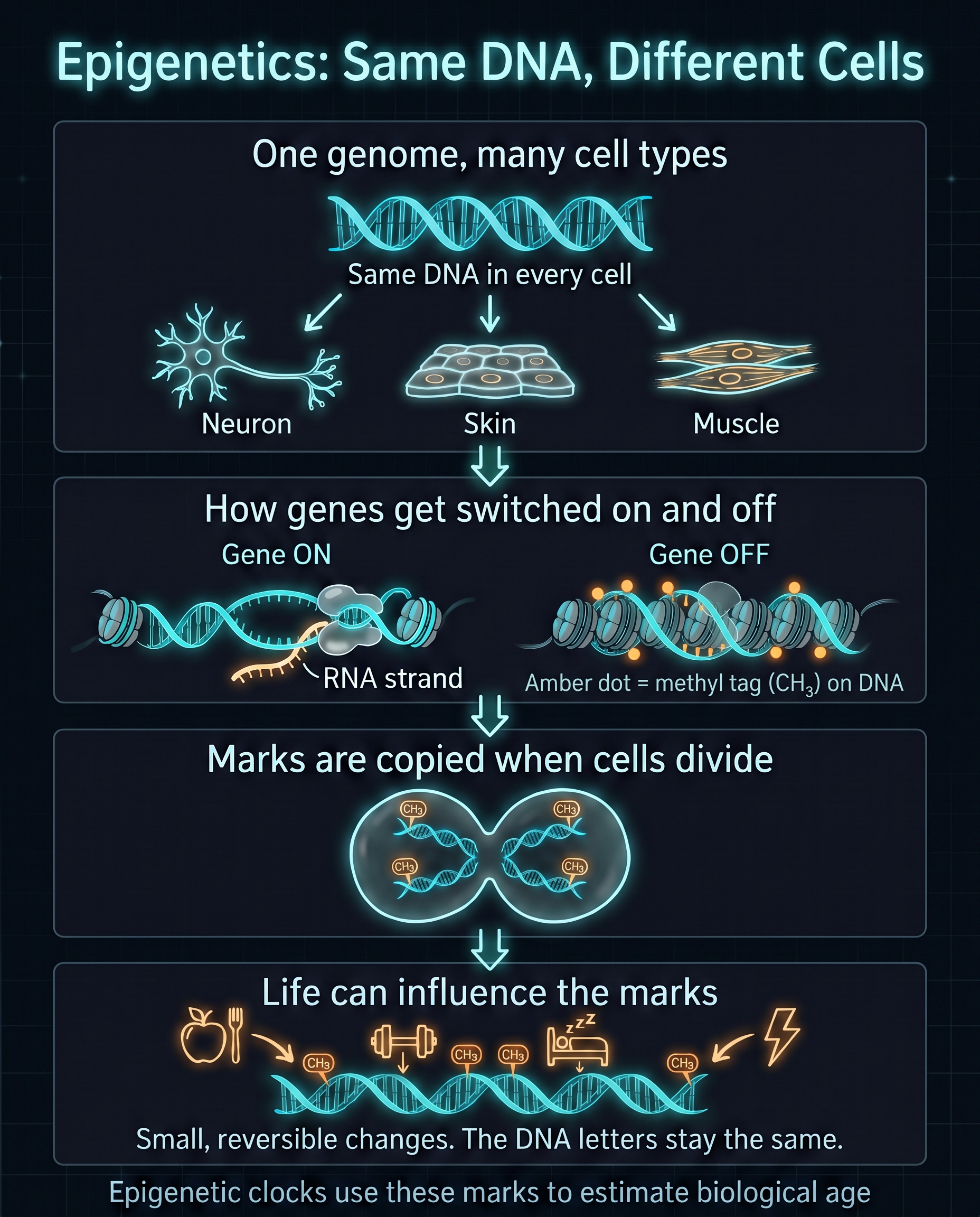
The part that excites people is that these marks respond to life. The best-known human example is the Dutch Hunger Winter of 1944–45: people who were conceived during the famine had measurably different DNA methylation at the IGF2 gene six decades later than their unexposed siblings (Heijmans et al., Proceedings of the National Academy of Sciences, 2008). Diet, smoking, exercise, stress, and age are all associated with methylation changes.
Two cautions, though. First, the “environment as API call” picture is too clean: real effects are usually small, tissue-specific, and often reversible, and much of the evidence is correlational. Second, the idea that experiences are inherited by grandchildren through epigenetic marks is well established in plants and worms but still unsettled in humans, so be skeptical of confident claims.
For the technically minded: methylation patterns change so predictably with age that they can be used as a clock. In 2013 Steve Horvath published a clock built on 353 CpG sites that estimates age from methylation across many tissue types, with a median error of about 3.6 years. Later clocks such as GrimAge were trained on mortality-linked markers and predict all-cause mortality and age-related disease better than calendar age does across populations. The caveat: published reviews argue today’s clocks are not yet reliable enough for individual clinical decisions, and direct-to-consumer “biological age” tests vary widely in quality. Treat them as research tools.
4. Stem Cells: Cells That Can Still Become Anything
Epigenetics explains how a cell keeps its identity. Stem cells show how identity gets assigned in the first place—and, as we’ll see, that it can be undone.
Biologists often picture development as a ball rolling down a hillside into one valley or another (Conrad Waddington’s “epigenetic landscape”). Methylation and histone marks are the walls of the valleys. For a long time the assumption was that the ball could never roll back uphill.
That assumption fell in two steps. In the 1960s John Gurdon showed that the nucleus of a specialized frog cell, transplanted into an egg, could produce a whole tadpole: the specialized cell had lost no genes, it had simply switched most of them off. Then in 2006 Shinya Yamanaka’s lab showed that adding just four genes—Oct4, Sox2, Klf4, and c-Myc, now called the Yamanaka factors—could reprogram mouse skin cells into stem-cell-like cells, which they named induced pluripotent stem cells (iPSCs). Human cells followed in 2007, and Gurdon and Yamanaka shared the 2012 Nobel Prize in Physiology or Medicine.
iPSCs matter because they can be made from a patient’s own skin or blood without using embryos. Researchers use them to build disease models in a dish, to screen drugs, and—in early clinical trials for conditions such as Parkinson’s disease and retinal disease—as a source of replacement cells.
For the technically minded: reprogramming is essentially an epigenetic event. The factors rewrite methylation and chromatin so the cell’s original identity is erased and pluripotency is re-established, with no change to the DNA sequence. It is slow and inefficient (only a small fraction of cells make the full trip), and fully reprogrammed cells can form tumors called teratomas. That risk is the central problem in the next section.
5. Rewinding the Clock: Partial Reprogramming and Aging
What if you didn’t push a cell all the way back to a stem cell, but only part of the way? That is partial reprogramming: switching on reprogramming factors briefly, long enough to reset age-related drift in a cell’s epigenetic marks while it remains what it was—a retinal neuron stays a retinal neuron.
The idea rests on a hypothesis championed by David Sinclair’s lab at Harvard: that a major driver of aging is loss of epigenetic information. The marks that tell a cell what it is gradually blur over time, like a disk accumulating read errors, even though the underlying DNA text stays largely intact. If that is right, aging may be at least partly reversible. The Veritasium video below is a good tour of this angle, covering both slowing aging through the body’s longevity genes and reversing it with Yamanaka factors.
The strongest evidence so far is in the eye. A 2020 paper in Nature (Lu et al.) delivered three of the four factors—Oct4, Sox2, and Klf4, leaving out c-Myc because of its link to cancer—to the retinal ganglion cells of mice. Treated cells recovered youthful DNA-methylation patterns, and vision improved in a mouse model of glaucoma and in aged mice.
Now it is reaching people. On June 9, 2026, Life Biosciences announced that the first participant had been dosed in a Phase 1 trial of ER-100, an injection into the eye that delivers the same three factors to patients with glaucoma or non-arteritic anterior ischemic optic neuropathy. By the company’s account, it is the first time a partial epigenetic reprogramming therapy has been given to a human. It is a safety trial, so the first questions are about harm, not benefit.
Keep the caveats in view. Mouse results often fail to translate to people. The loss-of-epigenetic-information idea is still debated. And too much reprogramming risks cells losing their identity and forming tumors, which makes dosing the central safety problem.
6. CRISPR: Find, Cut, and Repair
CRISPR began as a bacterial immune system. Bacteria store snippets of past viral invaders in their own DNA (the “clustered regularly interspaced short palindromic repeats” of the name) and use them, together with Cas enzymes, to find and cut matching viral DNA. In 2012 Jennifer Doudna and Emmanuelle Charpentier showed the system could be reprogrammed to cut any DNA sequence you choose, and they won the 2020 Nobel Prize in Chemistry for it.
The mental model:
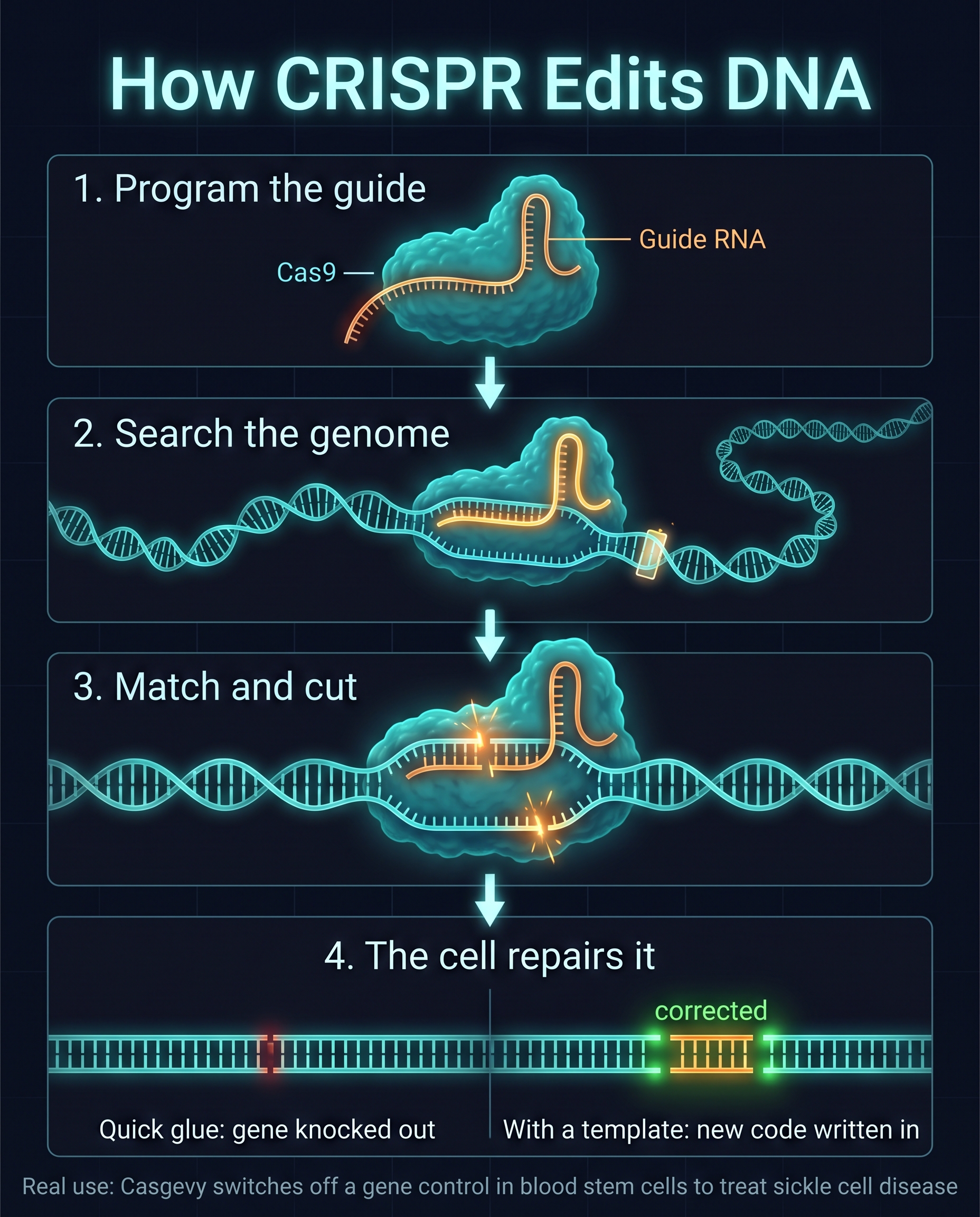
The first approved CRISPR medicine is Casgevy, cleared in the UK in late 2023 and by the U.S. FDA on December 8, 2023, for sickle cell disease (it was followed by approval for transfusion-dependent beta thalassemia). Notice what it edits. The disease comes from a typo in the adult hemoglobin gene, but Casgevy doesn’t fix that letter. Doctors collect a patient’s blood stem cells, use CRISPR-Cas9 to cut an enhancer that controls a gene called BCL11A—the switch that turns off fetal hemoglobin after birth—and return the edited cells to the patient. The body resumes making fetal hemoglobin, which works around the broken adult version. It is a regulatory, non-coding target, so section 2 pays off here. In the pivotal trial the large majority of evaluable patients were free of severe pain crises for at least a year. The treatment is demanding: it requires chemotherapy to clear space in the bone marrow, a hospital stay, and a very high price.
7. Beyond Cutting: Base, Prime, and Epigenome Editing
Cutting both strands of DNA is a blunt instrument. The cell’s repair is error-prone and can cause unintended insertions, deletions, or even chromosomal rearrangements. The next generation of editors avoids the double-strand break. David Liu of the Broad Institute offers a handy analogy: Cas9 is scissors, base editors are pencils, and prime editors are word processors.
Base editing has already been used to treat a patient. In 2025, doctors at the Children’s Hospital of Philadelphia and the University of Pennsylvania treated an infant known as KJ, who had a severe form of CPS1 deficiency, an ultra-rare metabolic disease, with a base editor custom-designed for his specific mutation. The team reported in the New England Journal of Medicine that they developed, tested, and obtained FDA clearance for the therapy in about seven months, and that KJ tolerated more dietary protein and needed less medication within weeks. It is one patient, not a trial, but it is a proof of concept for bespoke, one-off gene editing.
For the technically minded, the real bottleneck is delivery. Casgevy sidesteps it by editing cells outside the body (ex vivo, using electroporation) and putting them back. For tissue you can’t remove, the editor has to travel there. Lipid nanoparticles (LNPs) tend to collect in the liver, which is why KJ’s therapy targeted it. Adeno-associated viruses (AAVs) reach other tissues but have a tight cargo limit that large Cas-based editors strain against. Getting editors into the brain, muscle, or lung efficiently remains an open problem.
8. Ethical Guardrails and What Comes Next
As biological software engineering advances, the question shifts from what we can do to what we should allow.
Epigenetic approaches shift the debate a little. Epigenome editing and partial reprogramming don’t rewrite the sequence, and in principle can be reversed, which may lower some risks. But they also introduce unknowns of their own, such as how long a mark persists and whether a reprogrammed cell stays well-behaved for decades.
The horizon is programmable biology. As AI models improve at predicting what a change will do, and as DNA synthesis and delivery methods improve, medicine is shifting from treating symptoms to engineering targeted fixes designed on a computer before they are deployed. The pace of the last few years—approved CRISPR therapy, a bespoke base editor built in months, the first human reprogramming trial—suggests that the shift is real, though it will likely be slower, and more uneven, than the headlines imply.
The Cheat Sheet
LAYER             ANALOGY          WHAT CHANGES IT
Genetics (DNA)    Source code      Mutation, inheritance, gene editing
Epigenetics       Runtime config   Development, environment, age,
                                   epigenome editing
Stem cells        Blank profile    Reprogramming (Yamanaka factors)
CRISPR            Write access     Cuts or rewrites the DNA itself
Base/prime edit   Precise patch    Changes letters without a break
Keep Learning
Every video in this post, along with more science explainers, is collected in our course library.
Check out our complete collection of science courses and video deep-dives at SeriousCourses.com/sciencecoursesPrimary Sources
- Reprogramming to recover youthful epigenetic information and restore vision — Lu et al., Nature (2020): the mouse retinal study described in section 5.
- Genome-wide programmable transcriptional memory by CRISPR-based epigenome editing — Nuñez et al., Cell (2021): the CRISPRoff paper.
- Life Biosciences announces FDA clearance of the IND for ER-100 — Life Biosciences: the company’s announcement that the FDA cleared the ER-100 trial.
- Evaluating ER-100 for safety in people with glaucoma or NAION — ClinicalTrials.gov (NCT07290244): the trial registration.
Going Deeper: More Videos
More explainers on the topics above. They are not embedded in the post, but each adds a useful angle. Where a video is older, we say so.
- From DNA to protein - 3D — yourgenome: a short 3D animation of transcription and translation.
- Gene Expression and Regulation — Amoeba Sisters: how cells switch genes on and off.
- What is epigenetics? — TED-Ed (Carlos Guerrero-Bosagna): a five-minute animated introduction.
- Epigenetics: Why Inheritance Is Weirder Than We Thought — MinuteEarth: a short look at how experience might echo across generations (an area where the human evidence is still debated).
- Epigenetic Clocks Help to Find Anti-Aging Treatments — Steve Horvath at TEDxBerkeley: the creator of the first pan-tissue methylation clock explains the idea.
- The Rise and Fall of Stem Cell Research — SciShow: a seven-minute history of the field’s promise and setbacks.
- Professor Shinya Yamanaka describes his back-up plan if his risky stem cell experiments failed — Nobel Prize: a short clip of the discoverer in his own words.
- Genetic Engineering Will Change Everything Forever - CRISPR — Kurzgesagt: a popular 16-minute overview, made in 2016, so it predates base editing, prime editing, and approved therapies.
- How CRISPR lets us edit our DNA — Jennifer Doudna, TED (2015): a co-inventor of the technology explains how it works and why it matters.
- The era of therapeutic gene editing is here - David Liu — Broad Institute: a two-minute look at base and prime editing from their inventor.
- New CRISPR-based sickle cell treatment, explained — STAT: a two-minute explainer on Casgevy.
- The First CRISPR Gene Therapy Is Here — SciShow: a longer walk through what the first approved CRISPR therapy does.
- How Lipid Nanoparticles (LNPs) Dutifully Deliver mRNA — Moderna: a two-minute look at the delivery vehicle (a company video, and about mRNA rather than gene-editing cargo, but the delivery principle is the same).
- He Jiankui and the World’s First Gene-edited Babies — World Science Festival: a three-minute account of the 2018 germline-editing episode.
More From the Blog
- EconomicsHow Good Is the Economy, Really? What 27 Official Indicators SayOctober 4, 2026
Stocks are up 15%, but real pay is slipping 0.3%. Unemployment is low, but gas, interest rates, and thin savings tell a harsher story. Here is a data-first tour through the numbers driving the headline debate—no spin, no political commentary.
- EconomicsThe $40 Trillion Question: How the U.S. Debt Squeeze Unfolds — and What We Can Do About ItSeptember 27, 2026
The U.S. national debt just crossed $40 trillion, and interest now costs about $1 trillion a year. It won't end in a sudden default — it ends in a slow fiscal squeeze. Here's the timeline, the five paths nations use to escape heavy debt, the reforms with the most leverage, and what it all means for your portfolio.
- EconomicsThe Global Economic Engine: Rebalancing Capitalism and Socialism in the New Space RaceSeptember 12, 2026
Capitalism and socialism aren't opposites at war — they're two halves of the same economic engine, one generating thrust and one keeping it from overheating. Here's how that balance plays out in the US and Chinese economies, stress-tested by the live race to the lunar south pole.
- Economics⚡ Why Everyday Ratepayers Are Subsidizing Tech's Power BoomAugust 2, 2026
Since 2020, U.S. electric bills have jumped more than a third — and AI data centers and EV charging are two of the biggest reasons why. This is a firsthand account of what it actually costs to opt out with home solar and batteries, how utility accounting lets Big Tech and EV charging networks shift grid-upgrade bills onto ordinary ratepayers, and finally why the "Bring Your Own Clean Power" policy is the best way out of this rate surge.
- Ecology⚙️ Operating the Earth Engine: What Systems Engineering Teaches Us About Keeping a Planet HabitableJuly 26, 2026
Less than two weeks ago, the sun over the East Coast was a dull orange disc behind Canadian wildfire smoke — not a weather event so much as a telemetry reading. Earth behaves like a machine with feedback loops, operating limits, and control lags. Seven of its nine safety margins are now outside spec. Here's how to read the dashboard, and where we actually have our hands on the controls.
- Ecology🏜️ Green Energy vs. Green Earth: Finding the "Happy Percentage" for the World's DesertsJuly 23, 2026
AI's power hunger is pushing us toward paving the desert with solar panels. But a third of the planet is meant to be arid — and the world's largest desert quietly feeds the world's largest rainforest. A look at deserts, dust, and the 1.2% that could power everything without wrecking the rest.
- Permaculture🌼 The Curious Beginner's Guide to Backyard Permaculture: A Wildlife-Resistant Wildflower OasisJuly 16, 2026
Rabbits ate my wildflowers, so I stopped fighting nature and started designing with it. No-dig beds, scent rings, deer psychology, and one very clever L-shaped fence.
- Economics🪙 Beyond Currency: How Society Functions When Money Becomes ObsoleteJuly 7, 2026
Could humanity outgrow money entirely? An attempt at a skeptic-proof tour of the three pillars of a post-currency economy — the tech, the limits, the motivation — and what you can start building today.
- Artificial Intelligence🤖 Silicon Safety Nets: Why Tech Billionaires Love UBI — and Why Economists Are WorriedJuly 1, 2026
AI is now the #1 stated reason for layoffs, and Silicon Valley wants to send you a check. Inside the 2026 battle between the UBI dreamers and the inflation hawks.
- RocketsThe Weight of the Worlds: What Happens When We Drag the Asteroid Belt Home?June 25, 2026
Every sci-fi movie about space mining ends exactly where the real nightmare begins.
- CryptocurrencyQuantum vs. Crypto: Who Wins the Race for Your Digital Wealth?June 22, 2026
Google's quantum whitepaper compressed the timeline — here's what breaks, what holds, which coins are most exposed, and why today's slump is macro, not quantum.
- AzureWhat’s New in Microsoft Azure (Summer 2026)June 21, 2026
A SeriousCourses deep dive into the most important Azure updates shaping the cloud right now.
- Artificial Intelligence🚀 The Agentic Shift: Navigating the Top AI ModelsJune 15, 2026
GPT-5, Claude, Gemini, Grok — the old way of judging AI is dead. Here's a clear-eyed guide to the new league of specialized titans.
- Artificial Intelligence🌌 The AI Model Landscape in Mid-2026: A Guide to the FrontierJune 11, 2026
Claude, GPT-5.5, Gemini, Grok, DeepSeek — a clear-eyed guide to what each frontier model does best in mid-2026.
- Artificial Intelligence🌌 Coding in the Age of AI: A Brave New CurriculumFebruary 28, 2026
How AI is rewriting what it means to learn to code — a brave new curriculum for programming alongside intelligent tools.
- ProgrammingNew Programmer Guide for 2026 — Level Up Your Skills with Serious CoursesFebruary 26, 2026
Just starting out in code? A practical roadmap of skills, languages, and resources to level up as a new programmer in 2026.
- Quantum Computing🌌 Charting the Quantum Frontier: A Serious Courses GuideFebruary 25, 2026
Qubits, superposition, and the strange machinery of quantum computing — a clear-eyed guide to one of computing's most exciting frontiers.
- Artificial Reality🌌 Artificial, Augmented, Mixed, and Virtual RealityFebruary 24, 2026
AR, MR, and VR explained — the technologies blending the digital and physical worlds, and where to start exploring them.
- Cyber Security🕶️ Cyber Security & Ethical Hacking: Enter the Digital ArenaFebruary 16, 2026
The art of digital defense — encryption, vigilance, and ethical hacking. A curated entry point into the world of cyber security.
- Cryptocurrency🌐 Cryptocurrency, Blockchain & Web3: A Journey BeginsFebruary 15, 2026
A guided tour of digital currencies, blockchains, and the decentralized promise of Web3 — from high-level overviews to the mechanics underneath.
- Games🎮 Game Development: Your Indie Journey Starts HereFebruary 14, 2026
Godot, Unity, or Unreal? A beginner-friendly guide to choosing your engine and building your first indie game from concept to creation.
- RocketsRocket & Space Propulsion TechnologyFebruary 13, 2026
Rockets, in-space propulsion, and a little warp-drive theory — the systems we can build today and the visionary concepts that may shape tomorrow.
- AutomotivesAutomotive TechnologyFebruary 11, 2026
From combustion to EVs and autonomous systems — a curated tour through the technology reshaping how we move.
- AWSAmazon Web Services (AWS): Your 2026 Springboard with Serious CoursesFebruary 9, 2026
A clean, high-level introduction to the world's most widely adopted cloud platform — core services, certifications, and where to begin.
- AzureMicrosoft Azure: Your 2026 Launchpad with Serious CoursesFebruary 8, 2026
Your starting point for Microsoft Azure: why it stands out, the certification paths worth chasing, and a curated launchpad into the platform.
- GoogleGoogle Cloud: A Fresh 2026 Guide from Serious CoursesFebruary 7, 2026
The often-overlooked cloud that powers a huge share of enterprise infrastructure — where Google Cloud leads, why it matters, and how to start.
Contact Us
Questions or feedback about anything? We'd love to hear from you.
You can reach us at: support@seriousmindware.com