Online Courses in AI, Cybersecurity, Mathematics & More
Welcome to Serious Courses!
Your gateway to a Celestial Library of Learning. Here, each course is a star in a vast constellation of knowledge, handpicked for seekers of mastery. Some glimmer behind paywalls, others shine freely in the open sky—but all are portals to deeper understanding. Know of a course that belongs among these stars? Whisper it to us at support@seriousmindware.com. The archive expands with every voice.
From the Serious Courses blog.
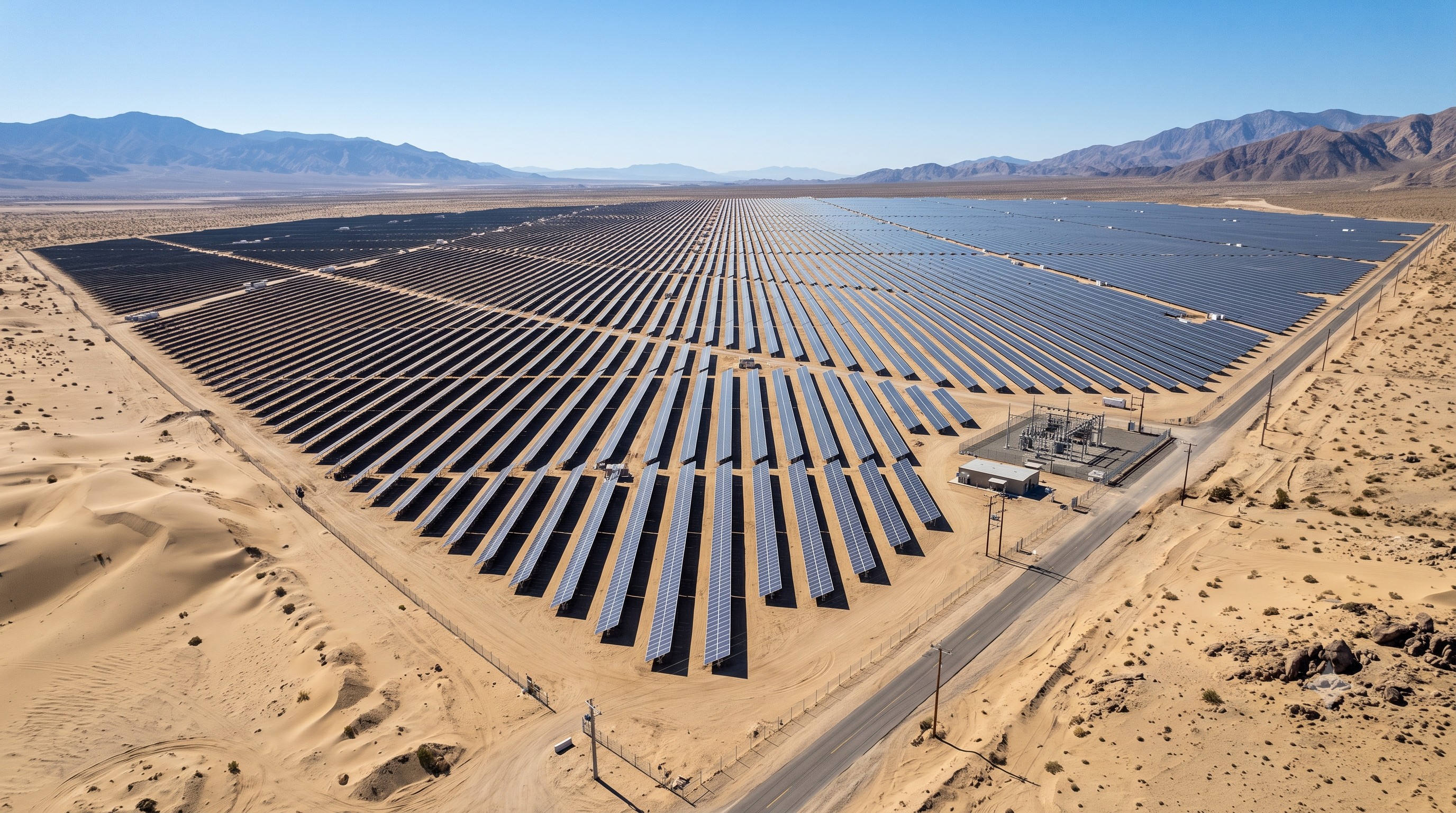
🏜️ Green Energy vs. Green Earth: Finding the "Happy Percentage" for the World's Deserts
Serious Courses! Every time you ask an AI to generate an image, write an essay, or crunch a dataset, a server farm somewhere burns through a startling amount of electricity. With AI data centers humming 24/7, humanity's appetite for clean power has shifted from a steady climb into an outright sprint.
To feed that appetite without choking the atmosphere with carbon, we naturally eye the empty, sun-drenched spaces of the world: our deserts. It looks like the ultimate win-win — pave the barren sand with solar panels, deliver electricity to the planet, and maybe even nudge the climate into "re-greening" the wasteland along the way.
But ecology has a habit of surprising us. Green isn't always good, and brown isn't always broken.
As we race to power our digital future, we're wandering into a delicate balancing act. Roughly a third of Earth's land is naturally arid — and that's not a flaw waiting to be fixed. It's a load-bearing part of how the planet works. Disrupt it carelessly, and the whole system can backfire.
The "Happy Percentage": Deserts vs. Desertification
Before we can talk about managing arid land, we have to clear up a costly misconception. To the untrained eye, all dry sand looks like a broken ecosystem. In reality, there's a world of difference between a natural desert and desertification.
Desertification is an environmental crisis. It's what happens when once-fertile grasslands or semi-arid regions are degraded by human activity — overgrazing, deforestation, poor farming — and collapse into barren dirt. Reversing it is a genuine global priority.
Natural deserts — the Sahara, the Mojave, the Gobi — are something else entirely: ancient, functioning, vital biomes. They aren't damaged land waiting for a human rescue. They're a feature, not a bug, of Earth's climate engine.
Natural deserts make up roughly a third of the planet's land surface. There's no magic number the Earth needs to hit — but the instinct to erase deserts and turn the whole globe lush would backfire spectacularly, because deserts do real work from thousands of miles away.
Case in point: the world's largest rainforest is quietly kept alive by the world's largest desert.
Watch: A NASA visualization — featuring the study's lead author — tracing how Saharan dust makes its trans-Atlantic journey to fertilize the Amazon.
Every year, trade winds lift enormous plumes of dust off the Sahara and carry them west along what NASA describes as a roughly 10,000-mile intermittent "river" of dust in the sky. About 27.7 million tons of it settles on the Amazon Basin — and buried in that dust is around 22,000 tons of phosphorus, almost exactly the amount the rainforest loses to its own heavy rains each year. Much of it originates in the Bodélé Depression in Chad, an ancient dried lakebed packed with the phosphorus-rich remains of long-dead microorganisms. The Amazon's own soils are old and phosphorus-poor; without that annual delivery, the world's most productive forest would slowly starve.
"Fix" the Sahara, in other words, and you may quietly begin starving the Amazon.
Deserts pull a second, subtler shift too. Their pale sands act like a giant mirror, bouncing a large share of incoming sunlight back into space — the albedo effect. Replace that bright surface with dark forest or dark solar panels and the Earth absorbs significantly more heat, which can warp wind patterns and jet streams in ways that are hard to predict.
The Eco-Healers: Re-Greening the Right Way
So if we want to leave the world's wild deserts alone, how do we address the millions of acres humans have accidentally ruined? Not by dumping water on sand — by partnering with nature.
A handful of innovators have pioneered ways to reverse human-caused desertification without touching ancient ecosystems.
The Underground Forest (FMNR). Australian agronomist Tony Rinaudo noticed that planting new saplings in arid zones usually fails — the sun kills them. So instead he pioneered Farmer-Managed Natural Regeneration: teaching communities to find, prune, and revive the vast, still-living network of tree roots hiding beneath cleared land. It's cheap, fast, and has helped regenerate millions of hectares across dozens of countries.
Watch: Tony Rinaudo on the "underground forest" — the living roots hiding beneath degraded land, and how pruning them re-greens the Sahel.
Ancient Zaï Pits. In Burkina Faso, the late Yacouba Sawadogo — known as "the man who stopped the desert" — revived a traditional practice of digging small pits into rock-hard dirt and filling them with organic compost. The compost draws termites, whose tunnels loosen the soil so that when the rare rains arrive, the pits trap the water perfectly. Over decades he coaxed a 40-hectare forest out of abandoned land, work that earned him the Right Livelihood Award ("the alternative Nobel") in 2018.
Watch: How the late Yacouba Sawadogo used ancient zaï pits and termites to coax a forest out of the Burkina Faso desert.
Holistic Planned Grazing. Biologist Allan Savory argues that tightly packed, constantly moving livestock herds can mimic wild migratory animals — trampling hardened soil crusts, burying seeds, and fertilizing degraded land back to life. His 2013 TED talk has been watched millions of times and has inspired a large regenerative-agriculture movement.
It's worth being straight with you here: Savory's ideas are influential but genuinely contested. A peer-reviewed rebuttal in the journal Rangelands concluded that his major claims were unsupported, and many controlled studies have failed to show holistic grazing outperforming other well-managed grazing systems. His boldest claim — that the method could reverse climate change — is widely regarded by scientists as unrealistic. Supporters, including the Savory Institute, point to on-farm results they say the controlled trials miss. Watch it as a provocative, unsettled idea rather than a proven fix.
Watch: Allan Savory's much-viewed (and much-debated) case for using managed livestock to reverse desertification — see the note above on the scientific pushback.
The Solar Paradox: Can Clean Energy Change the Weather?
Now back to our modern dilemma. Because tech companies need enormous power for their data centers, they're eyeing deserts for mega-solar projects. But blanketing a desert in dark panels doesn't just harvest electricity — it can nudge the weather.
Solar panels absorb most of the sunlight that hits them, converting only about 15–22% into electricity and shedding the rest as heat. That makes a solar farm a darker and rougher surface than the bright, smooth sand around it — and at large scale, those two properties matter.
A landmark 2018 study in Science modeled what would happen if wind and solar farms covered a massive stretch of the Sahara. The result: the lower albedo and increased surface roughness would more than double local rainfall, especially in the neighboring Sahel, and that extra rain would grow more vegetation, which would trap still more moisture — a self-reinforcing green feedback loop. The important caveat is scale: that study modeled coverage on a near-continental footprint, far larger than any real project.
The Micro-Oasis. There's a smaller, real-world version of this too. The panels cast wide shade, which slows evaporation and lets morning dew and light rain linger in the soil. In China's northwestern deserts, large arrays have measurably slowed near-surface winds, helped fix shifting dunes, and allowed vegetation to take hold beneath the panels.
Watch: A state-media showcase of desert-scale solar in China's Xinjiang — striking footage, worth viewing with that lens.
Here's the paradox, though: a solar farm that makes it rain is partly sabotaging itself. More rain means more cloud cover, and more clouds mean less sunlight reaching the panels — directly choking the clean power those AI data centers were counting on.
The 1.2% Solution: Sharing the Desert Safely
Does all this mean green energy is doomed to wreck the world's deserts? Not at all. The math of solar is so lopsided that we can power the future while leaving the overwhelming majority of our deserts completely wild.
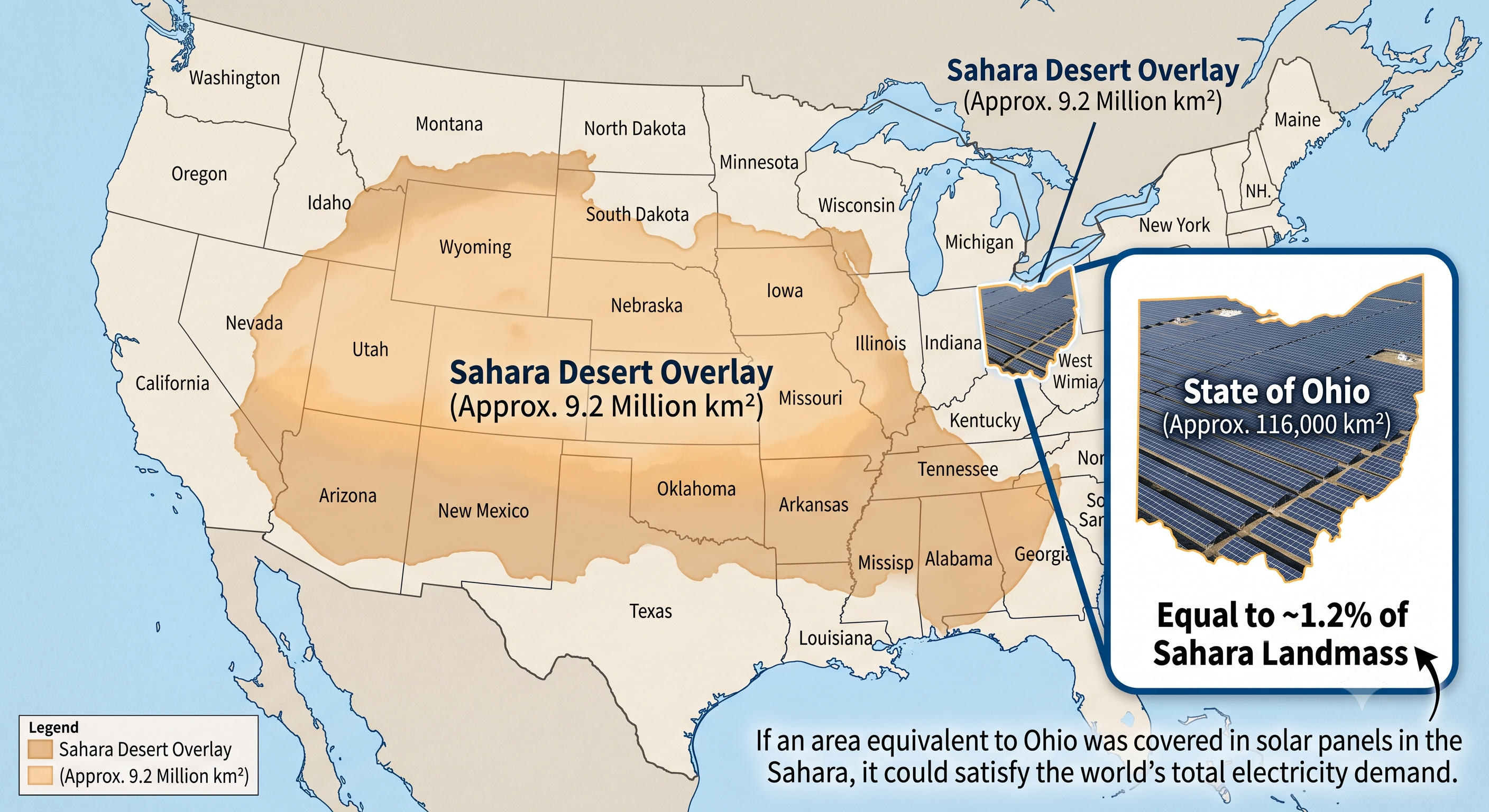
Consider the headline figure: covering just 1.2% of the Sahara in solar panels could, in theory, generate enough electricity to meet the entire world's demand.
Picture it: the Sahara is roughly the size of the continental
United States. That 1.2% slice works out to around 110,000 km2
— about the size of Ohio. (This is a back-of-envelope figure;
in the real world you'd also have to solve storage, nighttime,
and long-distance transmission losses.)
The real danger to the world's deserts isn't the amount of space we'd need. It's the economic temptation to build one giant, concentrated mega-farm to save money on power lines — because concentration is exactly what creates those continental-scale weather engines.
And the downside isn't hypothetical. Later modeling (Lu et al., 2021) found that covering more than about 20% of the Sahara could shift rainfall patterns, drive local warming, and cut Amazon precipitation by an estimated 10–30%. Read that against Section 1: a mega-farm big enough to change the weather could throttle the very dust-and-rain system that keeps the Amazon alive. The giant, tidy solar farm and the living rainforest are on a collision course.
The way out is the Sliver Strategy. Instead of one country-sized project, break that 1.2% allocation into small patches scattered across the world's deserts — a few square miles in the Mojave, a sliver in the Australian Outback, a patch in the Atacama. Distribute the panels and the local climate impact stays negligible, the micro-oasis effects stay small and benign, and the global desert system stays intact.
Becoming Smart Caretakers
The "happy percentage" we keep reaching for isn't a number we need to invent — nature already sorted it out. A third or so of the planet is meant to be arid, and it does essential work exactly as it is.
Our job, heading into a high-tech, AI-hungry future, isn't to shrink the desert toward zero. It's to use our engineering to harvest the energy we need from small, distributed slivers of wilderness — while pouring our re-greening efforts into healing the lands our own ancestors accidentally broke.
Keep the desert wild and the green lands growing, and both our technology and our planet can thrive together.
Footnotes: Further Watching
Want to go deeper on the eco-healers above? These are worth your time:
- The Forest Maker — Volker Schlöndorff's feature-length documentary on Tony Rinaudo's decades of regeneration work in the Sahel.
- The Man Who Single-Handedly Stopped the Desert — a second portrait of Yacouba Sawadogo's zaï-pit forest in Burkina Faso.
You can explore the full list of ecology videos and courses here:
Ecology Courses and VideosKnow a great video on deserts, solar energy, or land restoration that should be included? Send it our way at support@seriousmindware.com — we'd love to check it out.
More From the Blog
- EconomicsThe Tariff Ledger: What the Data Shows After the Supreme Court RulingOctober 17, 2026
Tariffs hit their highest level since 1936, then the Supreme Court struck most of them down. Here’s the ledger: revenue soared but $165 billion is being refunded, the trade deficit didn’t close, factory jobs didn’t grow, and about a quarter of the cost has reached store shelves so far.
- ScienceFrom Read-Only to Programmable: Genetics, Epigenetics, and the Age of Gene EditingOctober 9, 2026
Your DNA is the source code, epigenetics is the runtime that decides what runs, and CRISPR is the first tool with write access. A plain-language tutorial on the genome, epigenetics, stem cells, aging reversal, and gene editing, with a video for every concept.
- EconomicsHow Good Is the Economy, Really? What 27 Official Indicators SayOctober 4, 2026
Stocks are up 15%, but real pay is slipping 0.3%. Unemployment is low, but gas, interest rates, and thin savings tell a harsher story. Here is a data-first tour through the numbers driving the headline debate—no spin, no political commentary.
- EconomicsThe $40 Trillion Question: How the U.S. Debt Squeeze Unfolds — and What We Can Do About ItSeptember 27, 2026
The U.S. national debt just crossed $40 trillion, and interest now costs about $1 trillion a year. It won't end in a sudden default — it ends in a slow fiscal squeeze. Here's the timeline, the five paths nations use to escape heavy debt, the reforms with the most leverage, and what it all means for your portfolio.
- EconomicsThe Global Economic Engine: Rebalancing Capitalism and Socialism in the New Space RaceSeptember 12, 2026
Capitalism and socialism aren't opposites at war — they're two halves of the same economic engine, one generating thrust and one keeping it from overheating. Here's how that balance plays out in the US and Chinese economies, stress-tested by the live race to the lunar south pole.
- Economics⚡ Why Everyday Ratepayers Are Subsidizing Tech's Power BoomAugust 2, 2026
Since 2020, U.S. electric bills have jumped more than a third — and AI data centers and EV charging are two of the biggest reasons why. This is a firsthand account of what it actually costs to opt out with home solar and batteries, how utility accounting lets Big Tech and EV charging networks shift grid-upgrade bills onto ordinary ratepayers, and finally why the "Bring Your Own Clean Power" policy is the best way out of this rate surge.
- Ecology⚙️ Operating the Earth Engine: What Systems Engineering Teaches Us About Keeping a Planet HabitableJuly 26, 2026
Less than two weeks ago, the sun over the East Coast was a dull orange disc behind Canadian wildfire smoke — not a weather event so much as a telemetry reading. Earth behaves like a machine with feedback loops, operating limits, and control lags. Seven of its nine safety margins are now outside spec. Here's how to read the dashboard, and where we actually have our hands on the controls.
- Permaculture🌼 The Curious Beginner's Guide to Backyard Permaculture: A Wildlife-Resistant Wildflower OasisJuly 16, 2026
Rabbits ate my wildflowers, so I stopped fighting nature and started designing with it. No-dig beds, scent rings, deer psychology, and one very clever L-shaped fence.
- Economics🪙 Beyond Currency: How Society Functions When Money Becomes ObsoleteJuly 7, 2026
Could humanity outgrow money entirely? An attempt at a skeptic-proof tour of the three pillars of a post-currency economy — the tech, the limits, the motivation — and what you can start building today.
- Artificial Intelligence🤖 Silicon Safety Nets: Why Tech Billionaires Love UBI — and Why Economists Are WorriedJuly 1, 2026
AI is now the #1 stated reason for layoffs, and Silicon Valley wants to send you a check. Inside the 2026 battle between the UBI dreamers and the inflation hawks.
- RocketsThe Weight of the Worlds: What Happens When We Drag the Asteroid Belt Home?June 25, 2026
Every sci-fi movie about space mining ends exactly where the real nightmare begins.
- CryptocurrencyQuantum vs. Crypto: Who Wins the Race for Your Digital Wealth?June 22, 2026
Google's quantum whitepaper compressed the timeline — here's what breaks, what holds, which coins are most exposed, and why today's slump is macro, not quantum.
- AzureWhat’s New in Microsoft Azure (Summer 2026)June 21, 2026
A SeriousCourses deep dive into the most important Azure updates shaping the cloud right now.
- Artificial Intelligence🚀 The Agentic Shift: Navigating the Top AI ModelsJune 15, 2026
GPT-5, Claude, Gemini, Grok — the old way of judging AI is dead. Here's a clear-eyed guide to the new league of specialized titans.
- Artificial Intelligence🌌 The AI Model Landscape in Mid-2026: A Guide to the FrontierJune 11, 2026
Claude, GPT-5.5, Gemini, Grok, DeepSeek — a clear-eyed guide to what each frontier model does best in mid-2026.
- Artificial Intelligence🌌 Coding in the Age of AI: A Brave New CurriculumFebruary 28, 2026
How AI is rewriting what it means to learn to code — a brave new curriculum for programming alongside intelligent tools.
- ProgrammingNew Programmer Guide for 2026 — Level Up Your Skills with Serious CoursesFebruary 26, 2026
Just starting out in code? A practical roadmap of skills, languages, and resources to level up as a new programmer in 2026.
- Quantum Computing🌌 Charting the Quantum Frontier: A Serious Courses GuideFebruary 25, 2026
Qubits, superposition, and the strange machinery of quantum computing — a clear-eyed guide to one of computing's most exciting frontiers.
- Artificial Reality🌌 Artificial, Augmented, Mixed, and Virtual RealityFebruary 24, 2026
AR, MR, and VR explained — the technologies blending the digital and physical worlds, and where to start exploring them.
- Cyber Security🕶️ Cyber Security & Ethical Hacking: Enter the Digital ArenaFebruary 16, 2026
The art of digital defense — encryption, vigilance, and ethical hacking. A curated entry point into the world of cyber security.
- Cryptocurrency🌐 Cryptocurrency, Blockchain & Web3: A Journey BeginsFebruary 15, 2026
A guided tour of digital currencies, blockchains, and the decentralized promise of Web3 — from high-level overviews to the mechanics underneath.
- Games🎮 Game Development: Your Indie Journey Starts HereFebruary 14, 2026
Godot, Unity, or Unreal? A beginner-friendly guide to choosing your engine and building your first indie game from concept to creation.
- RocketsRocket & Space Propulsion TechnologyFebruary 13, 2026
Rockets, in-space propulsion, and a little warp-drive theory — the systems we can build today and the visionary concepts that may shape tomorrow.
- AutomotivesAutomotive TechnologyFebruary 11, 2026
From combustion to EVs and autonomous systems — a curated tour through the technology reshaping how we move.
- AWSAmazon Web Services (AWS): Your 2026 Springboard with Serious CoursesFebruary 9, 2026
A clean, high-level introduction to the world's most widely adopted cloud platform — core services, certifications, and where to begin.
- AzureMicrosoft Azure: Your 2026 Launchpad with Serious CoursesFebruary 8, 2026
Your starting point for Microsoft Azure: why it stands out, the certification paths worth chasing, and a curated launchpad into the platform.
- GoogleGoogle Cloud: A Fresh 2026 Guide from Serious CoursesFebruary 7, 2026
The often-overlooked cloud that powers a huge share of enterprise infrastructure — where Google Cloud leads, why it matters, and how to start.
Contact Us
Questions or feedback about anything? We'd love to hear from you.
You can reach us at: support@seriousmindware.com
Comments
No comments yet.