Online Courses in AI, Cybersecurity, Mathematics & More
Welcome to Serious Courses!
Your gateway to a Celestial Library of Learning. Here, each course is a star in a vast constellation of knowledge, handpicked for seekers of mastery. Some glimmer behind paywalls, others shine freely in the open sky—but all are portals to deeper understanding. Know of a course that belongs among these stars? Whisper it to us at support@seriousmindware.com. The archive expands with every voice.
From the Serious Courses blog.

How Good Is the Economy, Really? What 27 Official Indicators Say
Serious Courses! Depending on who you ask, the American economy is either firing on all cylinders or quietly bleeding working households dry.
Ask a stock market investor, and they’ll point to skyrocketing indexes. Ask a family sitting at the kitchen table, and they’ll show you a stack of grocery receipts and a 7% mortgage quote.
Here’s the plot twist: both perspectives are backed by official government data.
The Tale of Two Indicators:
This post is a guided walkthrough of our Live U.S. Economic Health Dashboard:
Open the Live U.S. Economic Health DashboardWe aren’t here to declare winners, award credit, or assign political blame. Every metric featured here comes directly from primary federal sources—the Bureau of Labor Statistics (BLS), Bureau of Economic Analysis (BEA), U.S. Treasury, and the Federal Reserve.
Note: The interactive cards on our dashboard update automatically as new data is published; the text below captures the economic snapshot as of October 2, 2026.
1. The Heavy Lifters: Where the Macro Foundation Holds
Let’s start with raw output. Real GDP—the total dollar value of everything produced in the U.S. after adjusting for inflation—grew at an annualized rate of 2.2% in Q2 2026, following a 2.5% clip in Q1. While down from the roaring 4.0% pace seen a year prior, it proves the economy is still expanding rather than shrinking.
Then there’s the headline labor market, where the September jobs report (released October 2) changes the tone. Unemployment ticked up to 4.2%, though that is still below the 4.4% of a year earlier. Employers added just 29,000 jobs in September, and the BLS revised August down to 133,000. The last three months have averaged about 51,000 new jobs a month, down from roughly 81,000 in the three months before that.
Watch: PBS NewsHour (October 2, 2026) on September’s hiring slowdown and what it signals for consumer prices and interest rates.
2. The Quiet Soft Spots: A "Low-Hire, Low-Fire" Labor Market
A low unemployment rate tells you that people who want work generally have a job—it doesn’t tell you if they can move up.
Meanwhile, broader underemployment (the U-6 rate, which includes discouraged workers and part-timers seeking full-time work) improved slightly to 7.6% in September. Summed up: it's a stable, "low-fire, low-hire" job market. People are employed, but momentum has cooled.
3. The Price Paradox: Disinflation vs. High Price Levels
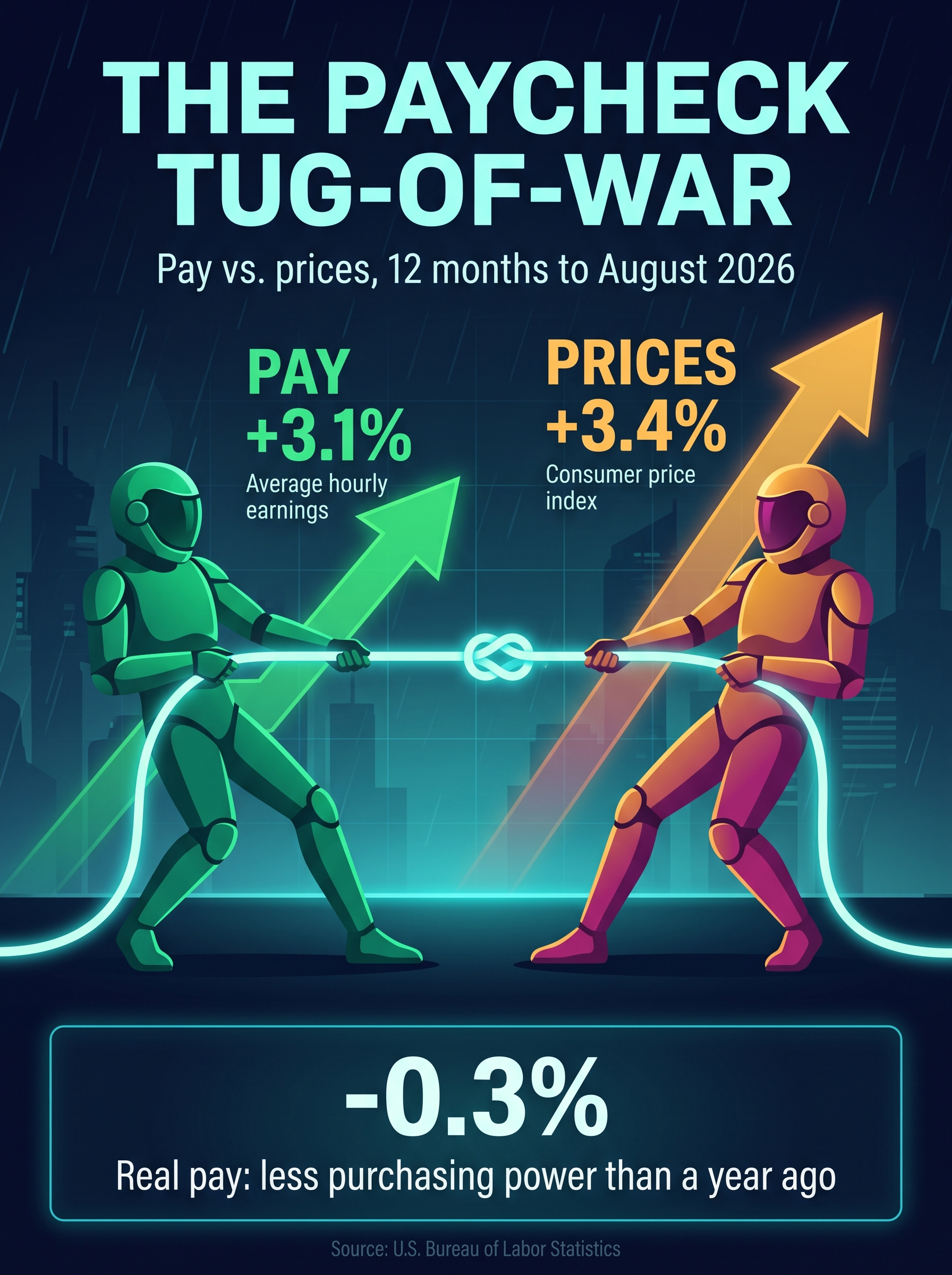
Headline CPI inflation sat at 3.4% in August 2026. However, the Federal Reserve’s preferred yardstick—Core PCE, which strips out volatile food and energy costs—came in at 3.0%. Both remain stuck above the Fed’s 2.0% target.
Why the gap between CPI (3.4%) and Core PCE (3.0%)? It isn’t groceries. Grocery store price growth slowed to 2.2% year-over-year, and dining out cooled to 3.4%.
Why Inflation Metrics Disconnect from Daily Reality:
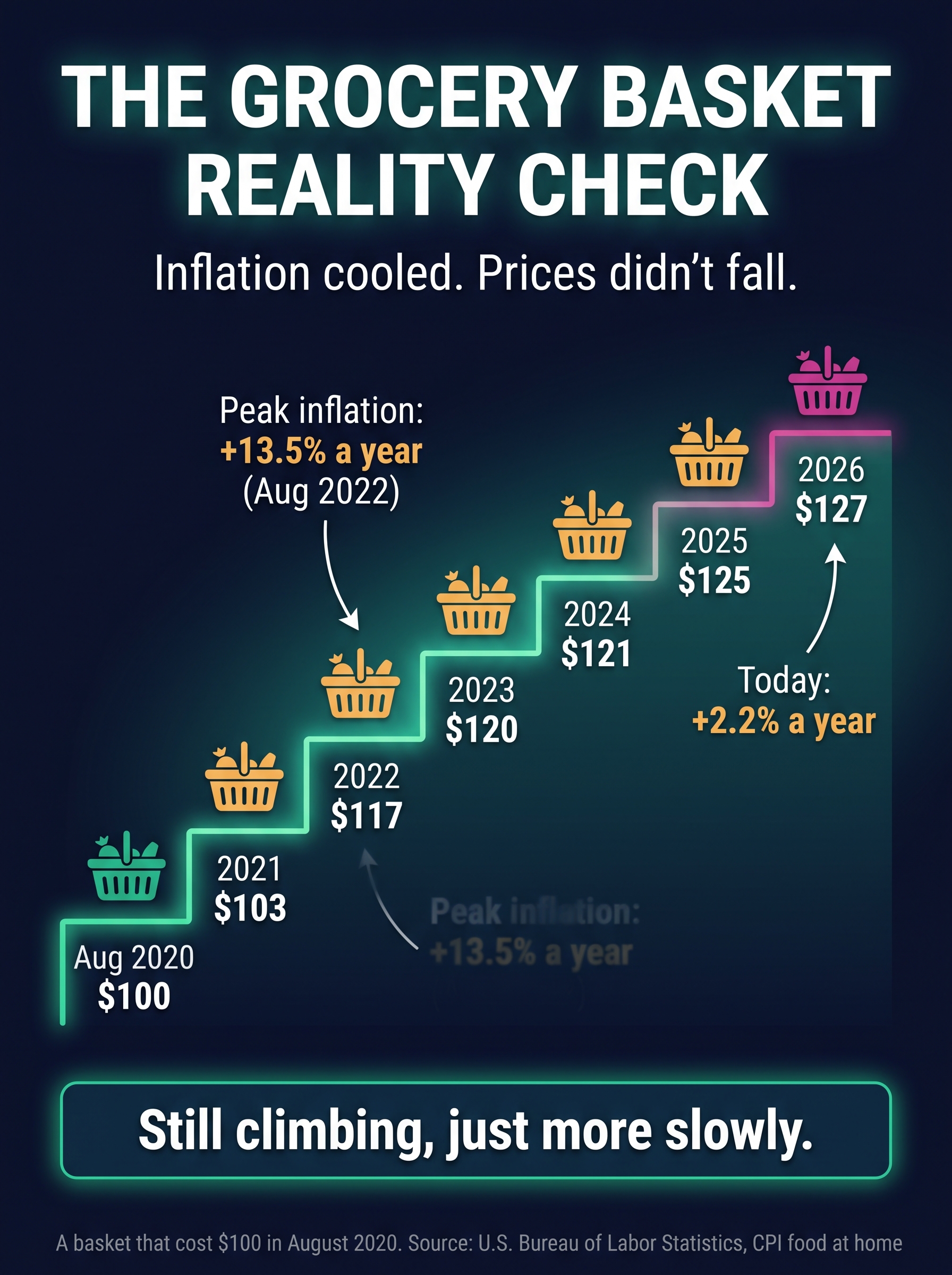
When economists celebrate grocery inflation dropping from a peak of 13.5% in August 2022 to 2.2% today, it means prices are rising at a slower pace—not that goods are getting cheaper. A basket of groceries that cost $100 in August 2020 costs about $127 today. The statistical rate has slowed, but the price tag hasn't dropped.
Watch: WSJ Your Money Briefing on why people remember lower prices, and why a cooling inflation rate still feels like paying more. (Recorded in March 2023, when inflation was 6%, so the figures have since changed; the idea hasn't.)
When pay growth (+3.1%) trails inflation (+3.4%), the real squeeze happens at the register.
Watch: WION on the Bureau of Labor Statistics’ real earnings report, which showed average hourly earnings falling 0.2% in July after adjusting for inflation. (August 2026.)
4. The Energy Wildcard: Geopolitics Hit the Pump
Energy is where the economic heat is concentrated. West Texas Intermediate (WTI) crude surged to ~$96 a barrel, up nearly 50% from $64 a year ago.
The driver? Ongoing shipping disruptions through the Strait of Hormuz—the vital maritime corridor that, according to the U.S. Energy Information Administration, carries roughly 20% of global petroleum consumption. Because diesel powers freight, trains, and agricultural equipment, high energy costs act as a lingering tax on the entire supply chain.
Watch: PBS NewsHour (September 24, 2026) on how the diesel price spike is rippling through nearly every part of the economy.
5. Mortgage Rates & The Housing Standoff
The Federal Reserve nudged its benchmark rate down to 3.88%, easing short-term borrowing costs. However, long-term bond markets drive mortgage rates—and the 10-Year Treasury yield jumped to 5.24%, up from 4.12% a year ago.
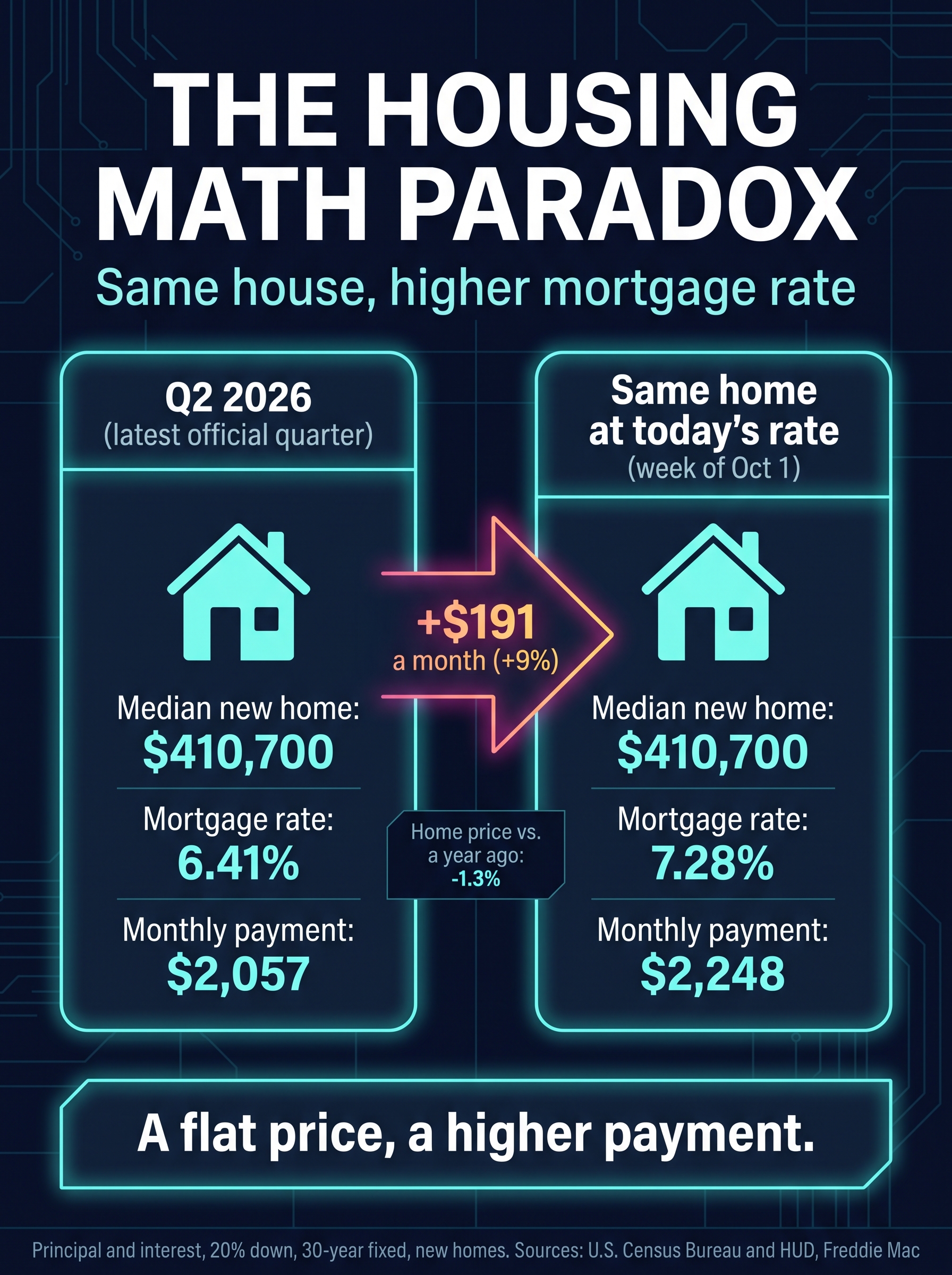
As a result, 30-year fixed mortgage rates spiked to 7.28% in the first week of October 2026, up from 6.34% a year earlier.
While median new home prices remained relatively flat ($410,700 vs. $416,100 a year ago), high mortgage rates have dramatically altered the math:
The Monthly Payment Breakdown:
Watch: PBS NewsHour (September 28, 2026) on the 30-year mortgage rate climbing back above 7%, and what rising Treasury yields mean for homebuyers.
6. Thin Cushions and the $40 Trillion Clock
How are households absorbing these pressures? One sign: they are saving less. The personal saving rate dropped to 4.1% in August 2026, down from 5.2% a year earlier. That can mean families are stretching to keep up, or simply that they feel confident enough to spend; the number alone can’t say which.
At the national level, the U.S. national debt topped $40.2 trillion, with the average interest rate paid by the Treasury ticking up to 3.49%. On a debt load of that magnitude, even fractional rate increases siphon significant capital into interest service.
The Bottom Line: Three Numbers That Matter Most
Rather than getting lost in 27 separate indicators, keep your eye on three core barometers:
Explore the Live Data
Want to inspect all 27 indicators updated live from official government feeds?
Visit the Live U.S. Economic Health DashboardCheck out our complete collection of economics courses and video deep-dives at SeriousCourses.com/economicscourses
Going Deeper: More Videos
A few more explainers on topics covered above. They are not embedded in the post, but each adds a useful angle.
- Mortgage Rates Hit 7%: What’s Next for the Housing Market? — WSJ News (September 2026): three charts on whether 7% mortgage rates will become the new normal.
- How the Iran War Is Rewiring the Oil Market — Bloomberg Originals (July 2026): why oil markets have proved more resilient than feared, and how global energy flows are shifting.
- September jobs report: hiring stalls, unemployment rises to 4.2% — Reuters (October 2026): a two-minute summary of the report behind this post’s labor-market numbers.
More From the Blog
- ScienceFrom Read-Only to Programmable: Genetics, Epigenetics, and the Age of Gene EditingOctober 9, 2026
Your DNA is the source code, epigenetics is the runtime that decides what runs, and CRISPR is the first tool with write access. A plain-language tutorial on the genome, epigenetics, stem cells, aging reversal, and gene editing, with a video for every concept.
- EconomicsThe $40 Trillion Question: How the U.S. Debt Squeeze Unfolds — and What We Can Do About ItSeptember 27, 2026
The U.S. national debt just crossed $40 trillion, and interest now costs about $1 trillion a year. It won't end in a sudden default — it ends in a slow fiscal squeeze. Here's the timeline, the five paths nations use to escape heavy debt, the reforms with the most leverage, and what it all means for your portfolio.
- EconomicsThe Global Economic Engine: Rebalancing Capitalism and Socialism in the New Space RaceSeptember 12, 2026
Capitalism and socialism aren't opposites at war — they're two halves of the same economic engine, one generating thrust and one keeping it from overheating. Here's how that balance plays out in the US and Chinese economies, stress-tested by the live race to the lunar south pole.
- Economics⚡ Why Everyday Ratepayers Are Subsidizing Tech's Power BoomAugust 2, 2026
Since 2020, U.S. electric bills have jumped more than a third — and AI data centers and EV charging are two of the biggest reasons why. This is a firsthand account of what it actually costs to opt out with home solar and batteries, how utility accounting lets Big Tech and EV charging networks shift grid-upgrade bills onto ordinary ratepayers, and finally why the "Bring Your Own Clean Power" policy is the best way out of this rate surge.
- Ecology⚙️ Operating the Earth Engine: What Systems Engineering Teaches Us About Keeping a Planet HabitableJuly 26, 2026
Less than two weeks ago, the sun over the East Coast was a dull orange disc behind Canadian wildfire smoke — not a weather event so much as a telemetry reading. Earth behaves like a machine with feedback loops, operating limits, and control lags. Seven of its nine safety margins are now outside spec. Here's how to read the dashboard, and where we actually have our hands on the controls.
- Ecology🏜️ Green Energy vs. Green Earth: Finding the "Happy Percentage" for the World's DesertsJuly 23, 2026
AI's power hunger is pushing us toward paving the desert with solar panels. But a third of the planet is meant to be arid — and the world's largest desert quietly feeds the world's largest rainforest. A look at deserts, dust, and the 1.2% that could power everything without wrecking the rest.
- Permaculture🌼 The Curious Beginner's Guide to Backyard Permaculture: A Wildlife-Resistant Wildflower OasisJuly 16, 2026
Rabbits ate my wildflowers, so I stopped fighting nature and started designing with it. No-dig beds, scent rings, deer psychology, and one very clever L-shaped fence.
- Economics🪙 Beyond Currency: How Society Functions When Money Becomes ObsoleteJuly 7, 2026
Could humanity outgrow money entirely? An attempt at a skeptic-proof tour of the three pillars of a post-currency economy — the tech, the limits, the motivation — and what you can start building today.
- Artificial Intelligence🤖 Silicon Safety Nets: Why Tech Billionaires Love UBI — and Why Economists Are WorriedJuly 1, 2026
AI is now the #1 stated reason for layoffs, and Silicon Valley wants to send you a check. Inside the 2026 battle between the UBI dreamers and the inflation hawks.
- RocketsThe Weight of the Worlds: What Happens When We Drag the Asteroid Belt Home?June 25, 2026
Every sci-fi movie about space mining ends exactly where the real nightmare begins.
- CryptocurrencyQuantum vs. Crypto: Who Wins the Race for Your Digital Wealth?June 22, 2026
Google's quantum whitepaper compressed the timeline — here's what breaks, what holds, which coins are most exposed, and why today's slump is macro, not quantum.
- AzureWhat’s New in Microsoft Azure (Summer 2026)June 21, 2026
A SeriousCourses deep dive into the most important Azure updates shaping the cloud right now.
- Artificial Intelligence🚀 The Agentic Shift: Navigating the Top AI ModelsJune 15, 2026
GPT-5, Claude, Gemini, Grok — the old way of judging AI is dead. Here's a clear-eyed guide to the new league of specialized titans.
- Artificial Intelligence🌌 The AI Model Landscape in Mid-2026: A Guide to the FrontierJune 11, 2026
Claude, GPT-5.5, Gemini, Grok, DeepSeek — a clear-eyed guide to what each frontier model does best in mid-2026.
- Artificial Intelligence🌌 Coding in the Age of AI: A Brave New CurriculumFebruary 28, 2026
How AI is rewriting what it means to learn to code — a brave new curriculum for programming alongside intelligent tools.
- ProgrammingNew Programmer Guide for 2026 — Level Up Your Skills with Serious CoursesFebruary 26, 2026
Just starting out in code? A practical roadmap of skills, languages, and resources to level up as a new programmer in 2026.
- Quantum Computing🌌 Charting the Quantum Frontier: A Serious Courses GuideFebruary 25, 2026
Qubits, superposition, and the strange machinery of quantum computing — a clear-eyed guide to one of computing's most exciting frontiers.
- Artificial Reality🌌 Artificial, Augmented, Mixed, and Virtual RealityFebruary 24, 2026
AR, MR, and VR explained — the technologies blending the digital and physical worlds, and where to start exploring them.
- Cyber Security🕶️ Cyber Security & Ethical Hacking: Enter the Digital ArenaFebruary 16, 2026
The art of digital defense — encryption, vigilance, and ethical hacking. A curated entry point into the world of cyber security.
- Cryptocurrency🌐 Cryptocurrency, Blockchain & Web3: A Journey BeginsFebruary 15, 2026
A guided tour of digital currencies, blockchains, and the decentralized promise of Web3 — from high-level overviews to the mechanics underneath.
- Games🎮 Game Development: Your Indie Journey Starts HereFebruary 14, 2026
Godot, Unity, or Unreal? A beginner-friendly guide to choosing your engine and building your first indie game from concept to creation.
- RocketsRocket & Space Propulsion TechnologyFebruary 13, 2026
Rockets, in-space propulsion, and a little warp-drive theory — the systems we can build today and the visionary concepts that may shape tomorrow.
- AutomotivesAutomotive TechnologyFebruary 11, 2026
From combustion to EVs and autonomous systems — a curated tour through the technology reshaping how we move.
- AWSAmazon Web Services (AWS): Your 2026 Springboard with Serious CoursesFebruary 9, 2026
A clean, high-level introduction to the world's most widely adopted cloud platform — core services, certifications, and where to begin.
- AzureMicrosoft Azure: Your 2026 Launchpad with Serious CoursesFebruary 8, 2026
Your starting point for Microsoft Azure: why it stands out, the certification paths worth chasing, and a curated launchpad into the platform.
- GoogleGoogle Cloud: A Fresh 2026 Guide from Serious CoursesFebruary 7, 2026
The often-overlooked cloud that powers a huge share of enterprise infrastructure — where Google Cloud leads, why it matters, and how to start.
Contact Us
Questions or feedback about anything? We'd love to hear from you.
You can reach us at: support@seriousmindware.com