Online Courses in AI, Cybersecurity, Mathematics & More
Welcome to Serious Courses!
Your gateway to a Celestial Library of Learning. Here, each course is a star in a vast constellation of knowledge, handpicked for seekers of mastery. Some glimmer behind paywalls, others shine freely in the open sky—but all are portals to deeper understanding. Know of a course that belongs among these stars? Whisper it to us at support@seriousmindware.com. The archive expands with every voice.
From the Serious Courses blog.
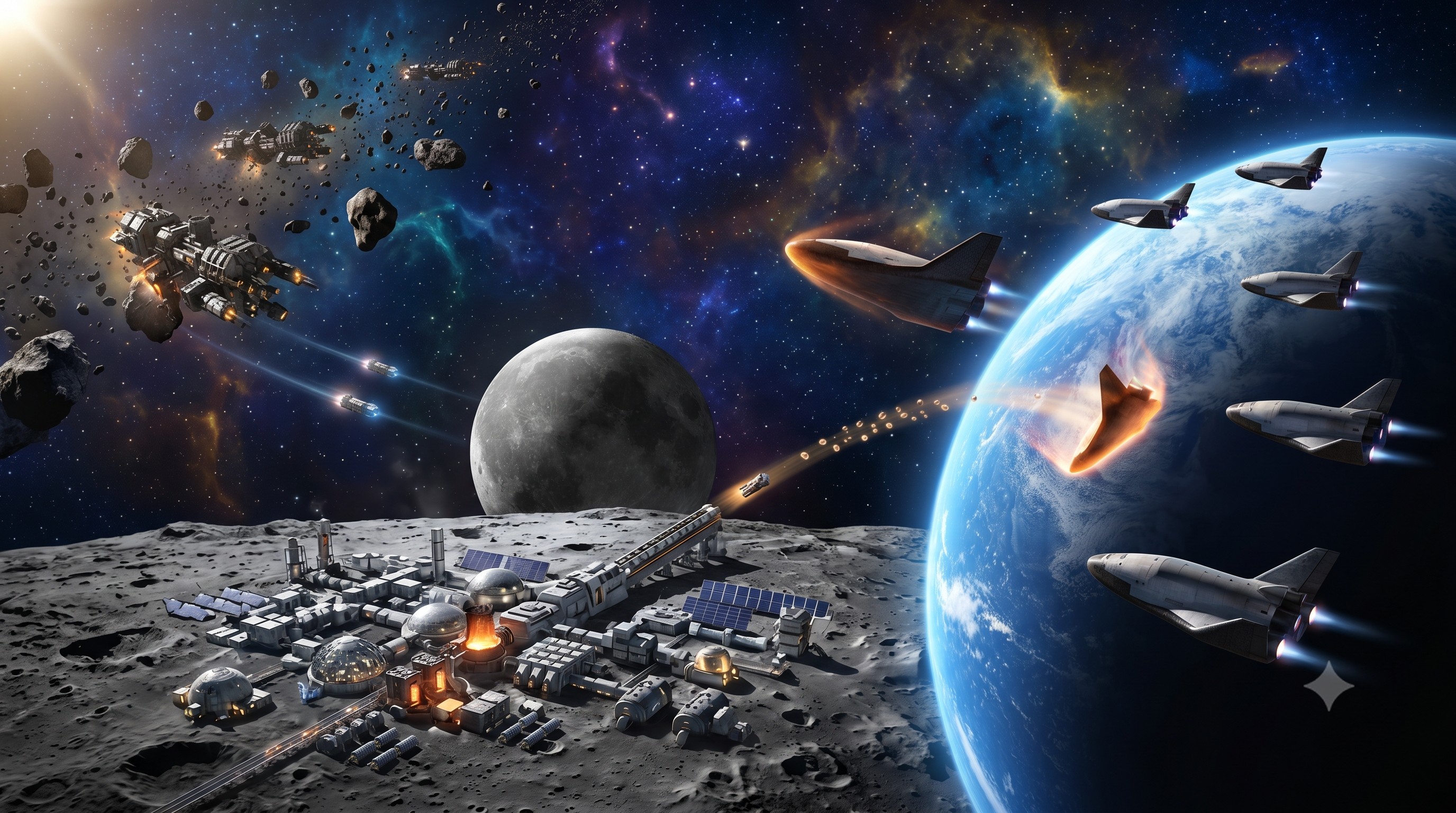
The Weight of the Worlds: What Happens When We Drag the Asteroid Belt Home?
Serious Courses! The rugged crew of blue-collar space heroes successfully lassos a platinum-rich asteroid, steers it into Earth’s orbit, and cheers as the screen fades to black. “We’re rich!” they shout, embracing a future of post-scarcity utopia.
But what the movies never show you is the logistical hangover. You can’t just dump a billion tons of unrefined space-ore onto the lawn of a Swiss bank. As it turns out, bringing the infinite wealth of the cosmos back to Earth forces us to confront the stubborn, unyielding, and occasionally hilarious laws of physics—and economics.
If we aren't careful, our trillion-dollar space hustle could accidentally cook the atmosphere, mess with the length of the workweek, or crash the global financial system. Or so the story goes. Let's check the math on each fear in turn — because most of them fall apart, and the one that doesn't is the one nobody puts in the movies.
Don’t Panic: The Earth is Heavy (Like, Really Heavy)
When people first think about hauling massive amounts of asteroid mass back to Earth, a few common anxieties bubble up. Could we get so heavy that we yank our satellites out of orbit? Could we add enough weight to reel the Moon back in and stop its slow drift away from us? It's a natural thought — more mass means more gravity, so surely if we imported enough, we could tug the Moon closer.
The short answer is: don't panic. Not only is the Earth an absolute unit, but the Moon's drift isn't a gravity-strength problem in the first place.
Here's the part that surprised us when we ran the numbers. The Moon recedes about 3.8 centimeters a year, and it's tempting to imagine we could counteract that by beefing up Earth's gravity. You actually can compute a tidy figure for it: holding the Moon's orbital momentum fixed, you'd need to add roughly 590 billion metric tons of mass to Earth to nudge the orbit inward by that 3.8 cm. But that calculation is answering the wrong question. The Moon isn't drifting away because Earth is too light — it's drifting because Earth's tidal bulge is constantly handing the Moon some of Earth's spin as orbital energy. Bolt 590 billion tons onto the planet and the tides keep shoving the Moon outward next year anyway. The mass doesn't touch the mechanism. There is no amount of imported rock that 'fixes' the drift; you'd just be adding weight to a process that ignores it.
Earth weighs roughly 5.97 × 10²⁴ kg. By comparison, the entire asteroid belt combined only weighs about 0.05% of Earth's total mass — and roughly a third of that is locked up in a single object, the dwarf planet Ceres.
Watch: Why the Moon is drifting away from us — and why it's about angular momentum handed off through Earth's tides, not about how much Earth weighs.
What if we got greedy and stacked our minerals on the Moon instead, hoping to juice the tides or just for storage? Tidal pull scales directly with the Moon's mass: make the Moon 10% heavier and you get tides roughly 10% stronger — noticeable, on the order of a few centimeters added to the open-ocean bulge, but a long way from drowning coastlines. And here's the kicker: even if we mined every single asteroid in the solar system, Ceres included, and piled all of it onto the lunar surface, the Moon's mass would climb by only about 4%. We couldn't move the needle on the tides even if that were the entire goal.
So, gravity isn't the problem. The real boss fights of space mining are much subtler.
Step 1: The Ultimate 'Not In My Backyard' Flex
Mining is messy. For every ton of pure platinum or rare earth metal you extract from an asteroid, you get tons of useless rock and toxic byproduct — slag. If we refine all of that material down here, we risk turning our atmosphere into a toxic soup.
The solution? The Moon Refinery.
[Asteroid Belt] ──> [Lunar Automated Refinery] ──> [Pure Cargo] ──> [Earth Fleet]
                          (Slag stays on the Moon)
By setting up automated, solar-powered smelters on the Moon, we practice the ultimate form of cosmic NIMBYism — Not In My Backyard. We do the dirty work on a rock that's already completely dead, leaving 95% of the useless weight behind. And because of the Moon's weak gravity and total lack of atmosphere, launching pure, refined metal bars off the lunar surface takes a fraction of the energy it would on Earth — lunar escape velocity is barely a fifth of Earth's, and since energy scales with the square of speed, you're looking at under 5% of the launch cost per kilogram.
Watch: A grounded look at how off-world mining and lunar processing would actually work — and why the real bottleneck has always been the economics, not the engineering.
But getting those pristine metal bars down to Earth's surface? That's where physics gets spicy.
Step 2: Turning the Sky Into a Toaster?
Here's the fear. If you just hurl a multi-billion-dollar block of pure gold from the Moon toward Earth, it becomes a meteor. It either vaporizes in the atmosphere (burning up your profits) or hits the ground like a bomb (ruining everyone's afternoon). And surely, the worry goes, dropping millions of tons of cargo from orbit every year dumps so much friction-heat into the sky that we cook the upper atmosphere and wreck the climate.
Except — run the numbers and the atmospheric oven myth melts away. Reentry heat is just the cargo's kinetic energy turned to warmth. Deliver a staggering ten million tons a year, and the total heat released equals roughly three and a half seconds of the sunlight Earth already soaks up every day. It's about one hundred-millionth of our annual solar input. The planet doesn't even notice. You could quadruple the fleet and still not budge a single climate average.
The real reentry problem isn't global, it's local: each delivery is a screaming, white-hot dart, and you do not want one going wrong over a city. The danger is concentrated heat and the risk of a pod surviving to the ground as a kinetic slug — an engineering problem, not a climate one. And that engineering problem is exactly what The Fleet is built to solve.
The Atmospheric Tanker Fleet
Instead of chaotic re-entry pods, Earth relies on a permanent, coordinated fleet of Space Gliders. Built on Earth with advanced thermodynamic shielding, these heavily armored, aerodynamically optimized lifting bodies are the supertankers of the upper atmosphere.
Orbital Skipping: A glider carrying 500 tons of lunar platinum won't do a traditional fiery dive. It hits the very top of the atmosphere, skips off it like a flat stone on a pond, sheds heat in the vacuum of space, and dips back in. Spreading a single descent over many passes keeps the heat shield from ever taking the full load at once. This one isn't science fiction — skip reentry was studied for the Apollo return trajectories and for long-range boost-glide vehicles. It's the legitimate, load-bearing trick of the whole operation.
Watch: Can a spacecraft dodge the inferno of reentry by slowing down or skipping off the atmosphere? The physics of why reentry heat is so hard to cheat.
The Planetary Spin Cycle: Here's a worry that sounds terrifying and turns out to be adorable. When a heavy tanker lands flying west to east, it hands a little orbital momentum to the planet — nudging Earth's spin like a hand brushing a basketball. Do it always in the same direction, the fear goes, and we speed up the day. So how much cargo would it actually take to shorten the day by a single millisecond? About 1.4 trillion tons, all landing the same way, with nothing ever landing the other way to cancel it — roughly 470 times the mass of the entire asteroid belt. In other words: the effect is real, and it is so microscopic that a logistics AI 'balancing the ledger of cosmic momentum' would be the most over-engineered bookkeeper in history. We keep one anyway, because cosmic tidiness is its own reward.
But getting those pristine metal bars all the way down to Earth's surface still has one more twist — and that's where the economics gets spicier than the physics.
Step 3: The Trillion-Dollar Dollar Store
Let's assume the engineering is flawless. The gliders skip smoothly through the sky, the heat is a non-event, and Earth's rotation is exactly as bored by us as it should be. Now you face the final, most terrifying villain of the cosmic frontier: Economics 101.
If you bring back an asteroid containing $10 trillion worth of platinum, you haven't made $10 trillion. To put the scale in perspective: the entire world mines only about 170 tons of platinum a year, and every gram of platinum ever refined in human history would fit into a cube roughly 25 feet on a side. A single metal-rich asteroid dwarfs that. Dump it onto that market and you haven't struck it rich — you've just made platinum as cheap and common as aluminum, bankrupting your own space program in the process. No asteroid-mining operation can survive its own oversupply.
So to survive, the first space-mining mega-corporations won't behave like NASA. They'll behave like diamond cartels — masters of artificial scarcity. (De Beers kept diamonds 'rare' for a century by sitting on a mountain of them; the same playbook scales to the heavens.)
Watch (Bloomberg): Why the most valuable resource in space may be something abundant back on Earth — a grounded look at the economics behind the trillion-dollar headlines.
The Shadow Ledger: To prevent a market panic, space tycoons will keep their true hauls strictly off the books. They'll scrub asteroid telemetry, classify cargo manifests as state secrets, and park their wealth in a Cosmic Vault — massive, hidden depots at stable gravitational points in space, where metal can sit indefinitely at no storage cost. Then they'll drip-feed it to Earth just slowly enough to keep prices sky-high. The scarcity isn't a side effect; it's the entire business model.
Read: Harvard International Review modeled exactly this scenario — including a simulation where a single shipment of space metals cut the price of gold in half, and the outsized harm that would fall on mineral-exporting developing economies.Watch (Harvard University): Love, Fear, and Greed: Why We Should Go to the Asteroids || Center for Astrophysics — Visionaries have argued that the mineral wealth in the asteroids is huge.
The Ledger: What Actually Threatens Us
Let's tally up the cosmic anxieties we started with. We were worried about a lot of things that, on inspection, can't hurt us.
Could imported mass yank the Moon back from its drift? No — the drift is driven by Earth's tides handing off spin, and no plausible amount of rock touches that mechanism. Could we overload the tides by piling minerals on the Moon? No — mining every asteroid in the solar system, Ceres included, would add only about 4% to the Moon's mass. Could re-entry heat bake the atmosphere? No — even ten million tons a year amounts to a few seconds of the sunlight Earth already absorbs. Could a one-directional landing fleet spin up the planet and shorten our day? No — you'd need on the order of a trillion tons, all one way, to shift the day by a single millisecond.
Notice the pattern. Every physical doomsday scenario requires a truly absurd quantity of material before Earth so much as twitches — trillions of tons, the whole belt and then some. And here's the twist that ties the whole story together: the one real constraint, economics, caps how much we'd ever actually bring home at a tiny fraction of that. The market collapses at thousands of tons; the planet wouldn't flinch until trillions. In other words, the very scarcity logic that makes space mining economically treacherous is also what guarantees the physics stays harmless. The only way to make the physical dangers real would be to deliberately ignore the economics — to haul home orders of magnitude more than any market could bear.
So the asteroid belt won't cook us, crush us, or knock us off our axis. The thing we actually have to get right isn't physics. It's us.
A Cautionary Tale for the Cosmos
This leaves humanity trapped in a genuinely frustrating paradox — and unlike the heat and the spin, this one doesn't dissolve when you check the math.
If a rogue miner breaks the monopoly and dumps an entire asteroid's worth of lithium or copper into the public domain, prices crater toward zero. On one hand, that kicks off a technological golden age: electric vehicles, grid-scale batteries, and clean-energy infrastructure suddenly become almost too cheap to meter. On the other, it instantly collapses Earth-based mining economies. That's not an abstract worry — artisanal and small-scale mining alone directly employs more than 40 million people, and in some developing nations it's the second- or third-largest employer there is, accounting for the bulk of export revenue. A price crash empties those livelihoods overnight.
But if the corporate cartels win instead, we stay locked in a manufactured-scarcity mindset. We keep gouging the Earth and burning fossil fuels, all while a century's worth of clean-energy materials sits sealed inside a vault orbiting the Moon — withheld, not because we lack it, but to protect investor portfolios.
We spend a lot of time looking at the night sky worrying about a massive asteroid slamming into Earth and wiping out civilization. As it turns out, that's the wrong fear. The real danger isn't an asteroid hitting the planet. It's what happens when we successfully catch one, bring it home safely — and let Wall Street decide what to do with it.
Want to go deeper on the science and engineering behind getting off this rock? Check out our Courses and Videos below — from rocketry fundamentals to orbital mechanics, they cover the real physics this thought experiment only gets to play with.
Rocket & Propulsion Technology Courses and VideosHave a correction, a sharper number, or a 'but what if at scale...' question? We'd love to hear it — drop us a line at support@seriousmindware.com and we may dig into it in a future post.
More From the Blog
- EconomicsThe $40 Trillion Question: How the U.S. Debt Squeeze Unfolds — and What We Can Do About ItSeptember 27, 2026
The U.S. national debt just crossed $40 trillion, and interest now costs about $1 trillion a year. It won't end in a sudden default — it ends in a slow fiscal squeeze. Here's the timeline, the five paths nations use to escape heavy debt, the reforms with the most leverage, and what it all means for your portfolio.
- EconomicsThe Global Economic Engine: Rebalancing Capitalism and Socialism in the New Space RaceSeptember 12, 2026
Capitalism and socialism aren't opposites at war — they're two halves of the same economic engine, one generating thrust and one keeping it from overheating. Here's how that balance plays out in the US and Chinese economies, stress-tested by the live race to the lunar south pole.
- Economics⚡ Why Everyday Ratepayers Are Subsidizing Tech's Power BoomAugust 2, 2026
Since 2020, U.S. electric bills have jumped more than a third — and AI data centers and EV charging are two of the biggest reasons why. This is a firsthand account of what it actually costs to opt out with home solar and batteries, how utility accounting lets Big Tech and EV charging networks shift grid-upgrade bills onto ordinary ratepayers, and finally why the "Bring Your Own Clean Power" policy is the best way out of this rate surge.
- Ecology⚙️ Operating the Earth Engine: What Systems Engineering Teaches Us About Keeping a Planet HabitableJuly 26, 2026
Less than two weeks ago, the sun over the East Coast was a dull orange disc behind Canadian wildfire smoke — not a weather event so much as a telemetry reading. Earth behaves like a machine with feedback loops, operating limits, and control lags. Seven of its nine safety margins are now outside spec. Here's how to read the dashboard, and where we actually have our hands on the controls.
- Ecology🏜️ Green Energy vs. Green Earth: Finding the "Happy Percentage" for the World's DesertsJuly 23, 2026
AI's power hunger is pushing us toward paving the desert with solar panels. But a third of the planet is meant to be arid — and the world's largest desert quietly feeds the world's largest rainforest. A look at deserts, dust, and the 1.2% that could power everything without wrecking the rest.
- Permaculture🌼 The Curious Beginner's Guide to Backyard Permaculture: A Wildlife-Resistant Wildflower OasisJuly 16, 2026
Rabbits ate my wildflowers, so I stopped fighting nature and started designing with it. No-dig beds, scent rings, deer psychology, and one very clever L-shaped fence.
- Economics🪙 Beyond Currency: How Society Functions When Money Becomes ObsoleteJuly 7, 2026
Could humanity outgrow money entirely? An attempt at a skeptic-proof tour of the three pillars of a post-currency economy — the tech, the limits, the motivation — and what you can start building today.
- Artificial Intelligence🤖 Silicon Safety Nets: Why Tech Billionaires Love UBI — and Why Economists Are WorriedJuly 1, 2026
AI is now the #1 stated reason for layoffs, and Silicon Valley wants to send you a check. Inside the 2026 battle between the UBI dreamers and the inflation hawks.
- CryptocurrencyQuantum vs. Crypto: Who Wins the Race for Your Digital Wealth?June 22, 2026
Google's quantum whitepaper compressed the timeline — here's what breaks, what holds, which coins are most exposed, and why today's slump is macro, not quantum.
- AzureWhat’s New in Microsoft Azure (Summer 2026)June 21, 2026
A SeriousCourses deep dive into the most important Azure updates shaping the cloud right now.
- Artificial Intelligence🚀 The Agentic Shift: Navigating the Top AI ModelsJune 15, 2026
GPT-5, Claude, Gemini, Grok — the old way of judging AI is dead. Here's a clear-eyed guide to the new league of specialized titans.
- Artificial Intelligence🌌 The AI Model Landscape in Mid-2026: A Guide to the FrontierJune 11, 2026
Claude, GPT-5.5, Gemini, Grok, DeepSeek — a clear-eyed guide to what each frontier model does best in mid-2026.
- Artificial Intelligence🌌 Coding in the Age of AI: A Brave New CurriculumFebruary 28, 2026
How AI is rewriting what it means to learn to code — a brave new curriculum for programming alongside intelligent tools.
- ProgrammingNew Programmer Guide for 2026 — Level Up Your Skills with Serious CoursesFebruary 26, 2026
Just starting out in code? A practical roadmap of skills, languages, and resources to level up as a new programmer in 2026.
- Quantum Computing🌌 Charting the Quantum Frontier: A Serious Courses GuideFebruary 25, 2026
Qubits, superposition, and the strange machinery of quantum computing — a clear-eyed guide to one of computing's most exciting frontiers.
- Artificial Reality🌌 Artificial, Augmented, Mixed, and Virtual RealityFebruary 24, 2026
AR, MR, and VR explained — the technologies blending the digital and physical worlds, and where to start exploring them.
- Cyber Security🕶️ Cyber Security & Ethical Hacking: Enter the Digital ArenaFebruary 16, 2026
The art of digital defense — encryption, vigilance, and ethical hacking. A curated entry point into the world of cyber security.
- Cryptocurrency🌐 Cryptocurrency, Blockchain & Web3: A Journey BeginsFebruary 15, 2026
A guided tour of digital currencies, blockchains, and the decentralized promise of Web3 — from high-level overviews to the mechanics underneath.
- Games🎮 Game Development: Your Indie Journey Starts HereFebruary 14, 2026
Godot, Unity, or Unreal? A beginner-friendly guide to choosing your engine and building your first indie game from concept to creation.
- RocketsRocket & Space Propulsion TechnologyFebruary 13, 2026
Rockets, in-space propulsion, and a little warp-drive theory — the systems we can build today and the visionary concepts that may shape tomorrow.
- AutomotivesAutomotive TechnologyFebruary 11, 2026
From combustion to EVs and autonomous systems — a curated tour through the technology reshaping how we move.
- AWSAmazon Web Services (AWS): Your 2026 Springboard with Serious CoursesFebruary 9, 2026
A clean, high-level introduction to the world's most widely adopted cloud platform — core services, certifications, and where to begin.
- AzureMicrosoft Azure: Your 2026 Launchpad with Serious CoursesFebruary 8, 2026
Your starting point for Microsoft Azure: why it stands out, the certification paths worth chasing, and a curated launchpad into the platform.
- GoogleGoogle Cloud: A Fresh 2026 Guide from Serious CoursesFebruary 7, 2026
The often-overlooked cloud that powers a huge share of enterprise infrastructure — where Google Cloud leads, why it matters, and how to start.
Contact Us
Questions or feedback about anything? We'd love to hear from you.
You can reach us at: support@seriousmindware.com