Online Courses in AI, Cybersecurity, Mathematics & More
Welcome to Serious Courses!
Your gateway to a Celestial Library of Learning. Here, each course is a star in a vast constellation of knowledge, handpicked for seekers of mastery. Some glimmer behind paywalls, others shine freely in the open sky—but all are portals to deeper understanding. Know of a course that belongs among these stars? Whisper it to us at support@seriousmindware.com. The archive expands with every voice.
From the Serious Courses blog.

The $40 Trillion Question: How the U.S. Debt Squeeze Unfolds — and What We Can Do About It
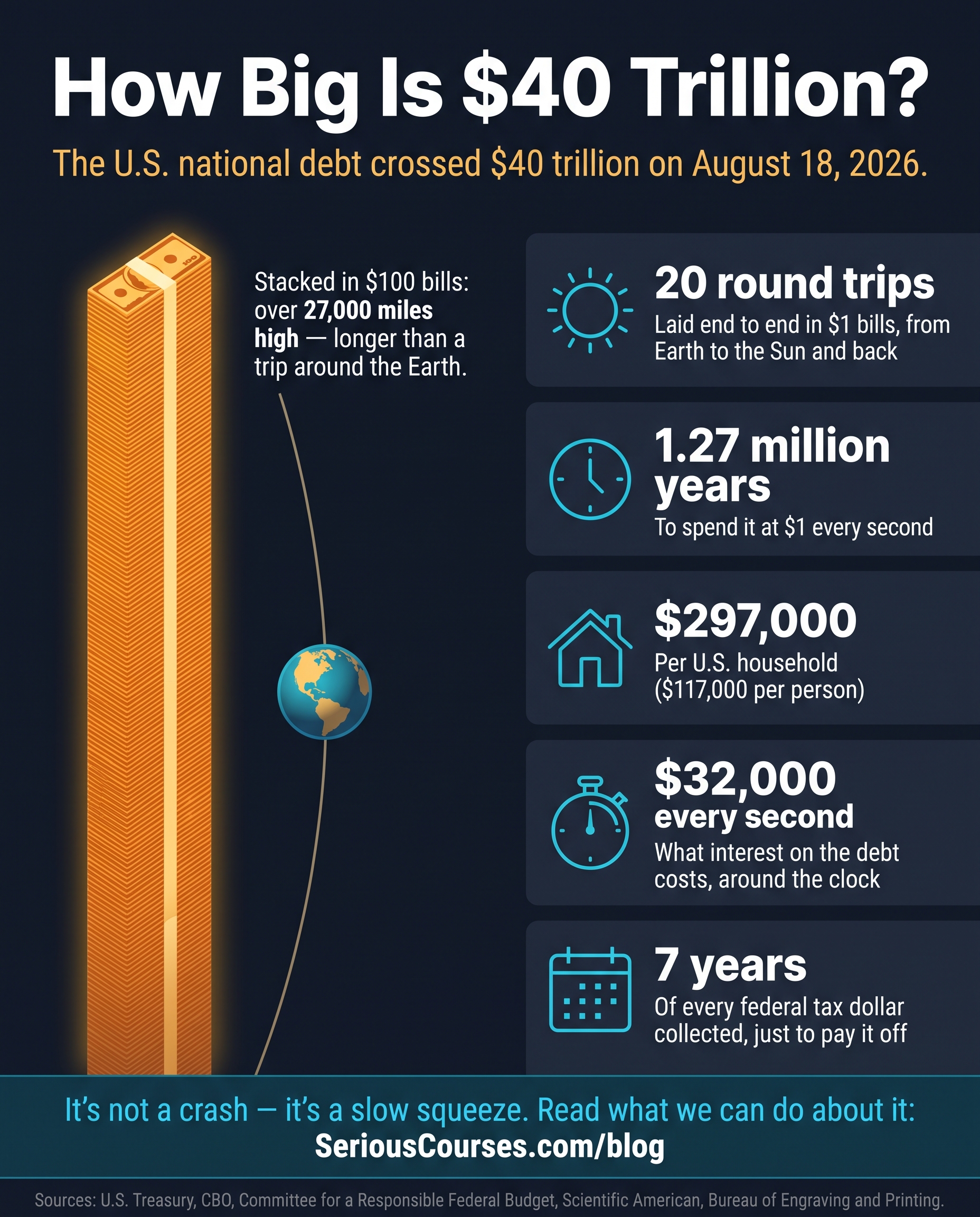
Serious Courses! On August 18, 2026, the U.S. gross national debt crossed $40 trillion — less than five months after it passed $39 trillion. Net interest on that debt now runs about $1 trillion a year, roughly 18 cents of every dollar the federal government collects. Interest now costs more than national defense and — net of the premiums seniors pay, the way the Congressional Budget Office tallies it — more than Medicare too, trailing only Social Security among the federal government's largest expenses.
For the average voter, headlines like these sound like a slow-motion catastrophe. For the savvy investor, they describe a complex macroeconomic environment defined by structural primary deficits, shifting bond yields, and monetary trade-offs. Both readings contain some truth — and both miss how the story actually unfolds.
The United States will not go bankrupt overnight like a household. Because the federal government borrows in the currency it issues, "trouble" doesn't arrive as a sudden default. It arrives as a compounding fiscal squeeze: higher borrowing rates that ripple into mortgages and auto loans, and a federal budget with less and less room to respond to anything new.
Watch: Ray Dalio's 30-minute animated breakdown of credit cycles, debt accumulation, and deleveraging — the clearest bridge between everyday voters and macro-minded investors.
The Timeline: When Does the Debt Squeeze Peak?
Rather than a single collapse date, the squeeze moves through three distinct thresholds — one we're already in, and two with dates attached.
1. The Interest Crossover (Now): In fiscal 2026, net interest costs consume roughly 18% of federal revenue, according to the Congressional Budget Office. Every dollar spent servicing past borrowing is a dollar not spent on future productivity — infrastructure, education, research — and the Treasury's growing appetite for credit competes with private borrowers for the same pool of capital.
Watch: The Brookings Institution walks through where federal revenue comes from and where it goes — Social Security, Medicare, defense, and the fast-growing slice for interest. (Recorded in 2023, so the dollar figures have since grown; the structure hasn't changed.)
2. The Trust Fund Cliffs (2032–2034): The 2026 Social Security and Medicare Trustees Reports project that Social Security's retirement trust fund (OASI) runs dry in late 2032, the combined Social Security funds in 2034, and Medicare's Hospital Insurance fund in 2033. Depletion doesn't mean benefits stop — incoming payroll taxes keep flowing — but by law, payments fall to what those taxes can cover unless Congress acts. That forces a choice between benefit cuts, revenue increases, or a large new wave of borrowing.
Watch: A June 2026 news report on the Trustees' new 2032 date — and what an automatic cut of roughly 22% would mean for the monthly checks of more than 70 million Americans.
3. The Term Premium Era (Mid-2030s): CBO projects debt held by the public rising from 101% of GDP this year to 120% by 2036 — higher than at any point in U.S. history, including the World War II peak of 106%. At those levels, bond investors can demand a larger "term premium" — extra yield for the risk of holding long-dated Treasuries. Higher yields raise interest costs, which raise borrowing, which feeds back into yields.
  deficits ──▶ more borrowing ──▶ higher debt/GDP
      ▲                                  │
      │                                  ▼
  higher interest costs ◀── higher term premium
The Options Matrix: How Nations Handle Heavy Debt
History offers only a handful of ways out of a sovereign debt surge, and every one of them hands the bill to somebody. Here's how the five main paths compare for voters and investors:
| Path | Economic Mechanism | Impact on Voters | Impact on Investors | Likelihood |
|---|---|---|---|---|
| 1. Growing Out of It (g > r) | Real growth (g) outpaces real interest rates (r), shrinking debt relative to GDP | Rising real wages, higher living standards, strong job market | High equity returns, robust earnings, strong private investment | Moderate — requires major productivity gains |
| 2. Financial Repression | Rates held below inflation; domestic institutions nudged or required to hold government debt | An "invisible tax" on cash savings as purchasing power erodes | Negative real yields on bonds; capital migrates to equities, real estate, and real assets | High — historically the most common tool |
| 3. Monetization & Inflation | Central bank buys debt at scale; inflation dilutes the real value of what's owed | Higher cost of living; squeezed purchasing power | Stocks and real estate act as nominal hedges; long bonds take real losses | Moderate to low — risks the dollar's reserve status |
| 4. Targeted Structural Reform | Bipartisan changes to entitlement formulas, tax loopholes, and the revenue base | Gradual, predictable adjustments to benefits or tax schedules | Stable Treasury market, lower rate volatility, policy certainty | Moderate — politically hard, structurally necessary |
| 5. Default or Severe Austerity | Debt restructuring, or abrupt spending cuts and tax hikes to balance the budget at once | Sharp cuts to services, recession, high unemployment | Credit freeze, sharp equity repricing, widespread instability | Extremely low |
In practice, countries rarely pick just one. The post-World War II United States reduced its debt ratio through a blend of strong growth, moderate inflation, and financial repression. The realistic question isn't which path we take — it's the mix, and who bears the cost of each ingredient.
A Blueprint for a Brighter Future: High-Impact Solutions
Resolving the squeeze while preserving economic dynamism requires frameworks that look past the next election. Four ideas carry the most leverage:
1. Adopt a Structural Fiscal Rule
Instead of recurring debt-ceiling standoffs that inject political uncertainty without actually restraining spending, the U.S. could adopt a structural rule modeled on Switzerland's "debt brake," approved by 85% of Swiss voters in 2001.
How it works: each year's spending ceiling equals expected revenue, adjusted for where the economy sits in the business cycle. In a boom, the ceiling lands below revenue and the government runs a surplus; in a recession, it lands above and deficits are allowed. Overspending is logged to a compensation account that must be paid back in later years. Over a full cycle, the budget balances — without forcing austerity in a downturn.
2. Modernize Entitlement Indexing
Mandatory programs — Social Security, Medicare, Medicaid, and others — make up about 61% of federal spending over the next decade, before interest, per CBO. Small changes made early prevent abrupt cuts later.
3. Broaden the Tax Base
Tax policy closes deficits best when it minimizes distortions to investment. Eliminating narrow deductions and special-interest tax expenditures broadens the base while keeping marginal rates competitive. A simpler code also cuts compliance costs and steers capital toward productive investment instead of tax-avoidance strategies.
4. Build the Productivity Engine
The cleanest path to debt stabilization is expanding the economy's productive capacity — raising g in the g > r equation. Comprehensive permitting reform for energy, transmission, and technology infrastructure (nuclear power, grid upgrades, AI data centers) shortens the years-long gap between approving a project and putting it to work. Faster builds raise productivity, and sustained growth above the government's borrowing rate is what shrinks debt relative to the economy.
The Investor Playbook: Portfolio Strategy in a High-Debt Regime
A high-debt macro regime doesn't call for panic, but it does reward rethinking a few standard allocation assumptions:
What About an Actual Default?
"Default" gets used for two very different events, and it's worth keeping them apart. An insolvency default — the government can't pay — is extremely unlikely, because U.S. debt is owed in dollars the government itself issues. As the options matrix shows, the realistic pressure valve for an overextended currency issuer is inflation, not missed payments.
A technical default — the government could pay but legally isn't allowed to borrow the money — is the real risk, and it comes from the debt ceiling. The July 2025 budget law raised the limit by $5 trillion, to $41.1 trillion. The Bipartisan Policy Center's June 2026 projection has the debt reaching that limit between late winter and mid-summer 2027, with Treasury's accounting workarounds ("extraordinary measures") running out six to nine months later. Congress has pushed past these deadlines at the last minute before, in 2011 and 2023, but the brinkmanship itself has cost the country: all three major rating agencies now rate the U.S. below AAA, most recently Moody's in May 2025.
Watch: USA TODAY explains how the debt ceiling works and what a U.S. default could mean for markets, interest rates, and retirement savings (September 2024 — before the 2025 increase, but the mechanics haven't changed).
Warning signs worth watching:
Hedging a tail risk like this is harder than it sounds. When S&P first downgraded the U.S. in August 2011, investors fled into Treasuries anyway — the 10-year yield fell from 2.56% to 2.32% on the next trading day. There's still no bigger or deeper safe asset, so the practical defenses are about exposure and timing, not betting on disaster:
These sections are general education, not personalized financial advice. Talk with a qualified advisor before making changes to your own portfolio.
The Bottom Line
The $40 trillion debt is not a countdown clock to a single day of reckoning. It's a slow tightening — of budgets, of interest rates, of the choices available to future voters. The good news is that the tools to loosen it are well understood: credible fiscal rules, gradual entitlement reform, a broader tax base, and an economy that builds faster. The sooner those tools are used, the smaller and gentler the adjustments have to be.
Further Watching
New to the topic? Start here.
Watch: Reuters on what the $40 trillion milestone actually means for household budgets — from mortgage rates to the roughly $117,000 in federal debt per American (August 2026).
- Deficits & Debts — Crash Course Economics: a clear primer on deficit vs. debt, who holds U.S. debt, and why a nation isn't a household. The concepts hold up; the figures date from 2015, when the debt was about $18 trillion.
- Just the Facts About the US Federal Budget — USAFacts: founder Steve Ballmer walks through revenue, mandatory and discretionary spending, and the deficit, number by number and without partisan spin (August 2024, FY2023 data).
Want the policy picture? Go deeper.
Watch: PBS NewsHour's Lisa Desjardins traces how the debt reached $40 trillion and why economists see the milestone as a warning sign, with the Concord Coalition's Carolyn Bourdeaux (August 2026).
Watching from the markets side?
Watch: Macro strategist Lyn Alden on The Investor's Podcast (May 2026) on "fiscal dominance" — why deficits this large can overpower the Fed's rate tools, and what that means for bonds, gold, energy, and the dollar. A useful counterpoint: her "nothing stops this train" view is that big deficits persist for years regardless of reform — without an imminent crisis.
- US National Debt on Brink of Passing $40 Trillion — Bloomberg's Balance of Power (August 18, 2026): full episode; the Committee for a Responsible Federal Budget's Maya MacGuineas on deficits, interest rates, and bond yields.
- Treasury Whiplash, US Debt Hits $40T — Bloomberg Money (August 21, 2026): how the bond market reacted to the milestone and the Treasury's debt-buyback surprise.
You can explore the full list of Economics videos and courses here:
Economics Courses and VideosKnow of a great video on the national debt, fiscal policy, or investing in a high-debt world that should be included? Send it our way at support@seriousmindware.com — we'll add it to the collection.
More From the Blog
- EconomicsThe Global Economic Engine: Rebalancing Capitalism and Socialism in the New Space RaceSeptember 12, 2026
Capitalism and socialism aren't opposites at war — they're two halves of the same economic engine, one generating thrust and one keeping it from overheating. Here's how that balance plays out in the US and Chinese economies, stress-tested by the live race to the lunar south pole.
- Economics⚡ Why Everyday Ratepayers Are Subsidizing Tech's Power BoomAugust 2, 2026
Since 2020, U.S. electric bills have jumped more than a third — and AI data centers and EV charging are two of the biggest reasons why. This is a firsthand account of what it actually costs to opt out with home solar and batteries, how utility accounting lets Big Tech and EV charging networks shift grid-upgrade bills onto ordinary ratepayers, and finally why the "Bring Your Own Clean Power" policy is the best way out of this rate surge.
- Ecology⚙️ Operating the Earth Engine: What Systems Engineering Teaches Us About Keeping a Planet HabitableJuly 26, 2026
Less than two weeks ago, the sun over the East Coast was a dull orange disc behind Canadian wildfire smoke — not a weather event so much as a telemetry reading. Earth behaves like a machine with feedback loops, operating limits, and control lags. Seven of its nine safety margins are now outside spec. Here's how to read the dashboard, and where we actually have our hands on the controls.
- Ecology🏜️ Green Energy vs. Green Earth: Finding the "Happy Percentage" for the World's DesertsJuly 23, 2026
AI's power hunger is pushing us toward paving the desert with solar panels. But a third of the planet is meant to be arid — and the world's largest desert quietly feeds the world's largest rainforest. A look at deserts, dust, and the 1.2% that could power everything without wrecking the rest.
- Permaculture🌼 The Curious Beginner's Guide to Backyard Permaculture: A Wildlife-Resistant Wildflower OasisJuly 16, 2026
Rabbits ate my wildflowers, so I stopped fighting nature and started designing with it. No-dig beds, scent rings, deer psychology, and one very clever L-shaped fence.
- Economics🪙 Beyond Currency: How Society Functions When Money Becomes ObsoleteJuly 7, 2026
Could humanity outgrow money entirely? An attempt at a skeptic-proof tour of the three pillars of a post-currency economy — the tech, the limits, the motivation — and what you can start building today.
- Artificial Intelligence🤖 Silicon Safety Nets: Why Tech Billionaires Love UBI — and Why Economists Are WorriedJuly 1, 2026
AI is now the #1 stated reason for layoffs, and Silicon Valley wants to send you a check. Inside the 2026 battle between the UBI dreamers and the inflation hawks.
- RocketsThe Weight of the Worlds: What Happens When We Drag the Asteroid Belt Home?June 25, 2026
Every sci-fi movie about space mining ends exactly where the real nightmare begins.
- CryptocurrencyQuantum vs. Crypto: Who Wins the Race for Your Digital Wealth?June 22, 2026
Google's quantum whitepaper compressed the timeline — here's what breaks, what holds, which coins are most exposed, and why today's slump is macro, not quantum.
- AzureWhat’s New in Microsoft Azure (Summer 2026)June 21, 2026
A SeriousCourses deep dive into the most important Azure updates shaping the cloud right now.
- Artificial Intelligence🚀 The Agentic Shift: Navigating the Top AI ModelsJune 15, 2026
GPT-5, Claude, Gemini, Grok — the old way of judging AI is dead. Here's a clear-eyed guide to the new league of specialized titans.
- Artificial Intelligence🌌 The AI Model Landscape in Mid-2026: A Guide to the FrontierJune 11, 2026
Claude, GPT-5.5, Gemini, Grok, DeepSeek — a clear-eyed guide to what each frontier model does best in mid-2026.
- Artificial Intelligence🌌 Coding in the Age of AI: A Brave New CurriculumFebruary 28, 2026
How AI is rewriting what it means to learn to code — a brave new curriculum for programming alongside intelligent tools.
- ProgrammingNew Programmer Guide for 2026 — Level Up Your Skills with Serious CoursesFebruary 26, 2026
Just starting out in code? A practical roadmap of skills, languages, and resources to level up as a new programmer in 2026.
- Quantum Computing🌌 Charting the Quantum Frontier: A Serious Courses GuideFebruary 25, 2026
Qubits, superposition, and the strange machinery of quantum computing — a clear-eyed guide to one of computing's most exciting frontiers.
- Artificial Reality🌌 Artificial, Augmented, Mixed, and Virtual RealityFebruary 24, 2026
AR, MR, and VR explained — the technologies blending the digital and physical worlds, and where to start exploring them.
- Cyber Security🕶️ Cyber Security & Ethical Hacking: Enter the Digital ArenaFebruary 16, 2026
The art of digital defense — encryption, vigilance, and ethical hacking. A curated entry point into the world of cyber security.
- Cryptocurrency🌐 Cryptocurrency, Blockchain & Web3: A Journey BeginsFebruary 15, 2026
A guided tour of digital currencies, blockchains, and the decentralized promise of Web3 — from high-level overviews to the mechanics underneath.
- Games🎮 Game Development: Your Indie Journey Starts HereFebruary 14, 2026
Godot, Unity, or Unreal? A beginner-friendly guide to choosing your engine and building your first indie game from concept to creation.
- RocketsRocket & Space Propulsion TechnologyFebruary 13, 2026
Rockets, in-space propulsion, and a little warp-drive theory — the systems we can build today and the visionary concepts that may shape tomorrow.
- AutomotivesAutomotive TechnologyFebruary 11, 2026
From combustion to EVs and autonomous systems — a curated tour through the technology reshaping how we move.
- AWSAmazon Web Services (AWS): Your 2026 Springboard with Serious CoursesFebruary 9, 2026
A clean, high-level introduction to the world's most widely adopted cloud platform — core services, certifications, and where to begin.
- AzureMicrosoft Azure: Your 2026 Launchpad with Serious CoursesFebruary 8, 2026
Your starting point for Microsoft Azure: why it stands out, the certification paths worth chasing, and a curated launchpad into the platform.
- GoogleGoogle Cloud: A Fresh 2026 Guide from Serious CoursesFebruary 7, 2026
The often-overlooked cloud that powers a huge share of enterprise infrastructure — where Google Cloud leads, why it matters, and how to start.
Contact Us
Questions or feedback about anything? We'd love to hear from you.
You can reach us at: support@seriousmindware.com